 United Kingdom vs Turkey
 United States vs Turkey
 Germany vs Turkey
 France vs Turkey
 Spain vs Turkey
 Sweden vs Turkey
 Denmark vs Turkey
 Finland vs Turkey
 Ireland vs Turkey
 Netherlands vs Turkey
 Norway vs Turkey
 Australia vs Turkey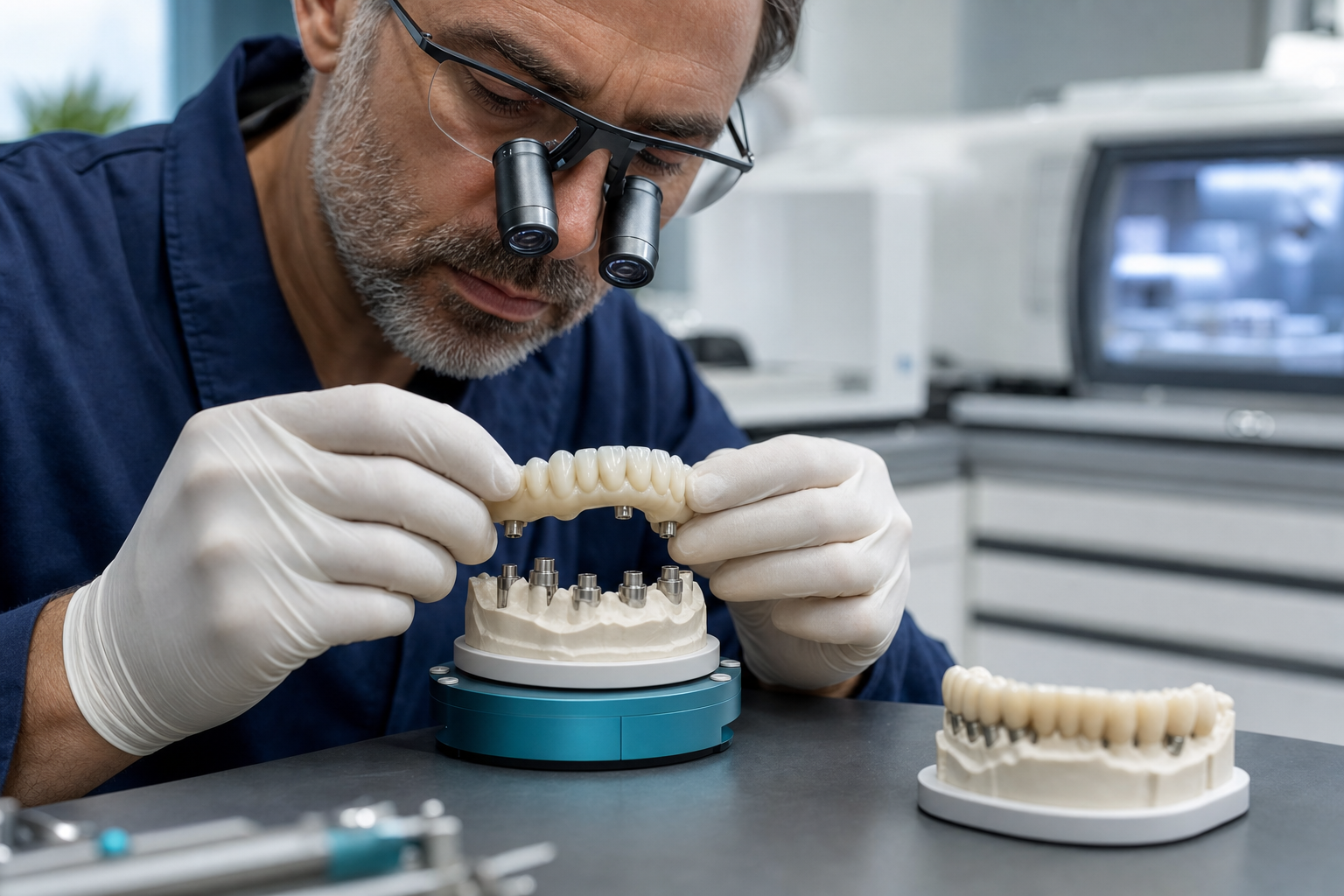
Clinical scope: This guide concerns zirconia fixed complete-arch implant prostheses. It distinguishes monolithic zirconia, veneered zirconia and zirconia connected through titanium bases or bars. It does not imply that the implant fixtures themselves are ceramic.
What is a zirconia hybrid prosthesis?
It is a fixed, screw-retained full-arch restoration in which zirconia forms most or all of the tooth-and-gingiva structure. It attaches to multiple implants, commonly through titanium cylinders, bases or multi-unit abutments. The patient does not remove it daily. It replaces both teeth and lost tissue and therefore requires planned hygiene space beneath the arch.
Zirconia bridge versus zirconia implants
A zirconia prosthesis commonly sits on titanium implants. The fixture material, abutment material and bridge material must be identified separately. Calling the treatment “metal-free” may be inaccurate when screws and bases are titanium. If avoiding metal is a patient priority, request a complete component list and discuss whether fully ceramic connections have adequate evidence for the proposed span.
Monolithic and veneered designs
Monolithic zirconia is milled largely as one structural ceramic, with staining or limited layering. Veneered zirconia has a zirconia framework covered by aesthetic ceramic. Veneering can improve characterisation but creates an additional chipping interface. A 2026 umbrella review reported higher chipping in veneered designs, while monolithic configurations showed different, generally lower technical complication patterns.
Why choose zirconia?
Zirconia offers high flexural strength, colour stability, resistance to wear and a smooth polishable surface. It avoids acrylic tooth debonding and can provide lifelike tooth contours. These advantages carry trade-offs: weight, difficult repair, demanding fit and potential catastrophic fracture. Material strength does not compensate for inadequate thickness, unsupported cantilever or inaccurate implant transfer.
Who may be considered?
Candidates require a full arch replacement and adequate restorative space for a validated zirconia design. They should have controlled biological risk, suitable implant distribution, manageable parafunction and the ability to clean. Patients with limited opening, extreme cantilevers, poor hygiene or a need for substantial adjustable lip support may benefit from another design.
Tooth prognosis first
Choosing an attractive ceramic should not determine whether teeth are extracted. The team assesses periodontal support, caries, cracks, restorability and endodontic prognosis. Keeping strategic teeth or using a removable solution may preserve options. Once bone is reduced for a zirconia hybrid, returning to a tooth-supported pathway is usually impossible.
Facial and prosthetic planning
Photographs, face scans, intraoral scans, jaw records and a trial tooth setup define smile, lip support and speech. CBCT provides bone information when justified. The prosthetic transition is planned above the visible smile line when possible. Zirconia is less adaptable after sintering than acrylic, so errors must be resolved in the provisional rather than deferred.
Restorative space
Zirconia requires sufficient vertical and buccolingual thickness around access channels, connectors and cantilevers. Too little space raises fracture risk; too much can produce a heavy, bulky prosthesis. Bone reduction may create room but sacrifices anatomy. A thinner-looking digital design is not acceptable if it violates the system or laboratory’s validated structural dimensions.
Implant distribution
Implants are positioned to support the arch and limit cantilevers while avoiding anatomy. Four versus six implants is not a simple quality ranking; evidence suggests survival may be comparable in selected designs, but redundancy, bone and prosthetic material matter. A rigid zirconia arch demands accurate alignment and a reliable restorative platform across all supports.
Titanium bases and interfaces
Zirconia often bonds to titanium cylinders or bases that engage implant or multi-unit connections. These protect the ceramic interface and allow screw retention. Bonding surface preparation, cement gap, base height and ceramic thickness influence durability. A debonded base may be rebonded in some cases, but repeated separation requires analysis of fit, load and design.
Immediate provisional phase
A milled or printed polymer provisional is usually connected during healing if immediate-loading criteria are met. It tests tooth position, speech, bite and cleaning while implants integrate. Delivering definitive zirconia too early can lock in tissue and occlusal errors. The provisional should remain long enough to establish a stable, documented design without being mistaken for permanent material.
Capturing implant positions
Conventional splinted impressions, intraoral scanning and photogrammetry may record multiple implants. Each technique has limitations. Full-arch errors can accumulate with distance, scan-body geometry and stitching. A verification jig or prototype confirms that the digital model matches the mouth before zirconia is milled. Accuracy is assessed clinically, not inferred from the device brand.
Passive fit
Zirconia does not flex into place safely. The prosthesis should seat completely without screw force. A one-screw test, visual inspection and radiographs may help verify interfaces. If it rocks or requires sequential tightening to close gaps, adjustment or remake is safer than forcing it. Grinding internal zirconia can introduce defects and does not necessarily correct the underlying data error.
Designing the pink portion
Pink zirconia or characterised ceramic replaces missing gingiva and hides the transition. Colour can be stable, but a single opaque block may look artificial. More importantly, the underside must remain convex and polished. Natural-looking concavities that trap plaque beneath the lip undermine biological maintenance. The patient should approve both visible and cleanable contours.
Aesthetic layering
Facial micro-layering can add translucency and texture without veneering the entire load-bearing surface. The more veneering ceramic used, the greater the potential area for chipping. The laboratory balances characterisation with structural support. Small facial chips may be repaired, but matching ceramic shade and polish chairside can be difficult.
Shade and tooth display
Full-arch shade is judged with skin, lips and opposing teeth rather than from a bright tab alone. Excessively opaque or white arches may appear artificial. Incisal length, midline and buccal corridor often influence appearance more than material. These are tested in the provisional and photographed in speech and full smile before definitive milling.
Speech and tongue space
Palatal thickness and anterior tooth position affect s, t, d, f and v sounds. Zirconia contours are harder to add to than acrylic after delivery. The provisional should test normal conversation, not only repeated words. A polished correction is possible within thickness limits, but large phonetic changes may require remilling the prosthesis.
Occlusion
A hard zirconia surface can resist wear but transmits force to screws, implants and the opposing dentition. Contacts are distributed, cantilevers controlled and excursive interferences reduced according to the case. Adjusted zirconia must be repolished with an appropriate sequence; a rough surface can abrade opposing enamel or restorations.
Opposing arch considerations
Zirconia against zirconia creates a different mechanical environment from zirconia against a complete denture. Natural teeth may move or wear while implants do not. The team considers material pairing, bite force and space. Sometimes a serviceable polymer opposing arch is strategically useful, but rapid wear can alter occlusion and require planned replacement.
Bruxism
Parafunction does not make zirconia unbreakable. It increases screw, interface, ceramic and opposing-tooth risk. A night guard may be recommended and should fit without concentrating load on cantilevers. Muscle symptoms and wear patterns are monitored. The patient should understand that a stronger arch may shift failure to a screw, implant or opposing restoration.
Cantilever and framework thickness
Posterior extensions create leverage. Their length is selected from implant spread, arch form, thickness, jaw and occlusion rather than a universal number. Zirconia needs smooth internal transitions because sharp corners concentrate stress. Access holes, gingival embrasures and titanium-base cut-outs must be designed without weakening critical sections.
Finishing and polishing
Sintering, glazing, staining and polishing affect surface and fit. Occlusal adjustment removes glaze, so polishing rather than reglazing alone is important for a smooth contact surface. The intaglio should be highly polished and free of inaccessible ledges. Laboratory documentation of zirconia formulation and sintering protocol helps interpret future fracture.
Cleaning beneath zirconia
Use floss threaders, superfloss, interdental brushes and/or a water irrigator as demonstrated. Hard ceramic can still accumulate plaque at an uncleanable contour. The bridge should allow tools around every implant without forcing or injuring tissue. If bleeding persists, professional examination is needed rather than stronger rinses alone.
Professional maintenance and removal
Reviews assess tissue, probing, radiographic changes when indicated, screw access, occlusion, polish and cracks. Evidence does not define one removal schedule for all full arches. Risk-based removal may improve access but carries screw and interface handling. If removed, each screw is tracked and the arch is supported carefully to avoid impact.
Chipping
Veneering ceramic is more likely to chip than a fully monolithic surface. Small defects may be polished or repaired with resin; extensive fractures can require laboratory repair or remake. Repair colour and durability may be imperfect. The team assesses insufficient support, impact, bite and framework flexure before treating the visible chip.
Framework fracture
Full-thickness zirconia fracture is uncommon in well-designed arches but potentially catastrophic. Repairing a structural split predictably is difficult, and replacement is often needed. Causes can include thin sections, internal defects, poor fit, unsupported cantilever, trauma or heavy parafunction. Digital files shorten remake time only if implant and tissue conditions remain unchanged.
Screw and base complications
Screws can loosen or fracture and titanium bases can debond even when zirconia remains intact. Movement must be assessed promptly. Forcing a loose arch into function may damage several interfaces. Proper torque, complete seating, compatible components and controlled occlusion reduce risk. Access-hole fillings are replaceable service items.
Biological complications
Zirconia’s smooth surface does not make the restoration immune to peri-implant disease. Mucositis and peri-implantitis relate strongly to plaque, contour, risk history and maintenance. A 2026 review of implant materials found comparable biological outcomes between zirconia and titanium fixtures within available evidence, but that does not answer whether a bulky zirconia bridge is cleanable.
Evidence and follow-up limits
A 2026 meta-analysis reported high proportions of monolithic zirconia arches in function over mostly 12- to 62-month follow-up, but heterogeneity was substantial and certainty low. This is encouraging short- to medium-term evidence, not proof of lifetime superiority. Older materials have longer observation, while newer monolithic protocols continue to evolve.
Treatment abroad and repair
Obtain implant and multi-unit details, titanium-base and screw references, torque values, zirconia brand or formulation, design and CAD files, shade and laboratory contact. Confirm whether a local laboratory can polish, rebond or remake the arch. Shipping a fractured full arch internationally without a usable temporary creates major functional risk.
Questions to ask
- Is the design monolithic, micro-layered or fully veneered?
- What titanium interfaces are present?
- How were implant positions and passive fit verified?
- Where are the thinnest sections and cantilevers?
- How will repair or remake be managed?
- Can I demonstrate cleaning before final delivery?
Frequently asked questions
Is it completely metal-free?
Usually not. Titanium implants, bases, abutments and screws commonly remain even when the visible arch is zirconia.
Can zirconia stain?
It is colour stable, but surface deposits can accumulate and characterised layers or repairs may change. Professional polishing may be needed.
Can a broken arch be repaired?
Small veneering defects may be repaired, but structural monolithic fracture often requires replacement.
Sources and clinical review references
- Matos et al. Reliability of monolithic zirconia complete-arch implant prostheses.
- Tomar et al. Complete-arch prosthetic complications: umbrella review.
- Delucchi et al. Framework materials for full-arch implant rehabilitation.
- Lanzetti et al. Supportive care and prosthesis removal.
Editorial review note: Evidence reviewed 22 July 2026. This educational draft requires named dental-clinician review before indexation.