
 United Kingdom vs Turkey
 United States vs Turkey
 Germany vs Turkey
 France vs Turkey
 Spain vs Turkey
 Sweden vs Turkey
 Denmark vs Turkey
 Finland vs Turkey
 Ireland vs Turkey
 Netherlands vs Turkey
 Norway vs Turkey
 Australia vs Turkey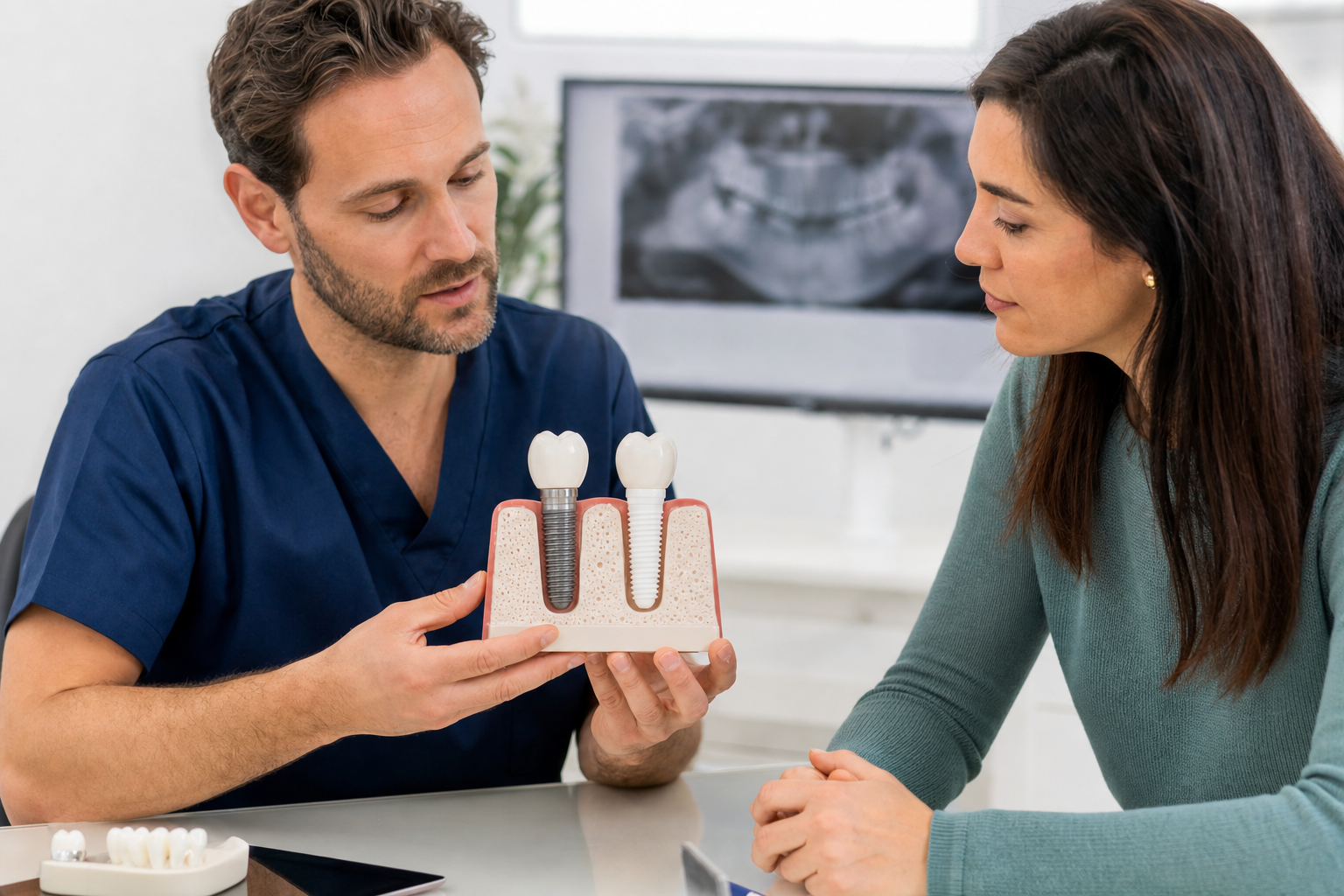
Clinical scope: This guide concerns zirconia implant fixtures, not merely zirconia crowns or abutments. It compares available designs, evidence, fracture considerations and maintenance without claiming that one material is universally safest.
What is a zirconia dental implant?
A zirconia dental implant is a ceramic fixture placed in jawbone to support a replacement tooth or prosthesis. Most contemporary systems use yttria-stabilised zirconia formulations engineered for strength and phase stability. The material is tooth-coloured rather than metallic grey. That aesthetic characteristic may be useful in selected thin-tissue sites, but it does not by itself determine biological or restorative success.
Zirconia implant versus zirconia crown
Patients often confuse the implant with the visible restoration. A titanium fixture can support a zirconia crown, and a zirconia fixture can support crowns made from several dental ceramics. An abutment may also be titanium, zirconia or hybrid. Any comparison must identify which component is being discussed because evidence about zirconia abutments does not automatically apply to zirconia implant bodies.
Why patients consider metal-free implants
Common reasons include concern about grey show-through, a personal preference to avoid metal or a history of unexplained reactions. “Metal-free” is a material description, not proof of better health. Some zirconia systems contain metal components in screws or restorative bases, so the complete component list should be checked when avoiding metal is an important patient value.
Material structure and ageing
Zirconia gains toughness from transformation mechanisms within its crystalline structure. Composition, grain size, processing and surface treatment influence strength. In moist environments, low-temperature degradation can change the surface over time, although modern formulations are designed to limit it. Clinical relevance depends on the exact system; broad statements about all zirconia ignore meaningful manufacturing differences.
One-piece zirconia implants
In a one-piece design, implant and abutment form a single ceramic component. This removes an implant-abutment microgap and screw but fixes the restorative angle at surgery. The coronal portion usually remains exposed during healing and may receive unwanted force. Preparation after placement can damage the surface or weaken the component, so three-dimensional positioning and provisional protection are critical.
Two-piece zirconia implants
Two-piece systems separate implant and abutment, improving restorative flexibility and allowing submerged healing in some designs. Connections may use screws, cemented abutments or specialised retention mechanisms. The connection is a mechanically demanding region. Long-term evidence and component availability vary among systems, so clinicians should not assume parity with mature titanium connections without product-specific data.
Clinical evidence compared with titanium
Systematic reviews report encouraging short- to medium-term zirconia outcomes, but the evidence base remains smaller, more heterogeneous and generally shorter than that for titanium. Some analyses find similar marginal bone changes, while others report lower zirconia survival or insufficient data for firm equivalence. Newer 2026 reviews continue to refine comparisons, but longer independent follow-up remains important.
Why survival percentages require context
A percentage is meaningful only with follow-up length, implant generation, site, loading protocol and number of patients. Early one-piece systems should not automatically define modern two-piece performance, yet favourable results from one design cannot be transferred to another. Implant survival also does not capture abutment fracture, crown repair, tissue recession or patient-reported outcomes.
Soft-tissue response
Zirconia can support healthy peri-implant tissues when position, contour and hygiene are appropriate. Laboratory observations about bacterial adhesion or inflammatory response are not enough to promise less peri-implantitis clinically. Controlled clinical evidence has not established a universal biological advantage. Plaque control, periodontal history, smoking, emergence contour and maintenance remain powerful determinants.
Aesthetic indications
A tooth-coloured fixture may reduce grey show-through in a high-smile-line patient with thin tissue, especially if recession occurs. However, the implant should still be placed within a three-dimensional restorative envelope and supported by adequate facial bone and tissue. A white implant in a facially incorrect position can produce a worse result than a well-planned titanium implant.
Patient assessment
Assessment includes the reason for tooth loss, periodontal stability, medical history, smoking, bite, parafunction, restorative space and cleaning ability. Photographs and digital scans define the intended tooth. CBCT may be indicated to assess bone and critical anatomy. A material preference is incorporated only after confirming that the available zirconia system can meet the anatomical and mechanical demands.
Material sensitivity concerns
Patients with suspected metal reactions deserve respectful evaluation, but symptoms should not be attributed to titanium without differential diagnosis. Plaque, infection, cement, component loosening, overload and unrelated oral disease are common alternatives. Patch testing and lymphocyte-based tests have limitations for titanium. Consultation with relevant medical specialists may be appropriate before irreversible removal of a functioning implant.
Planning position and angle
Zirconia is less forgiving of intraoral modification than metal, particularly in one-piece designs. Implant angulation must permit suitable crown contour and occlusion without extensive grinding. A surgical guide can help transfer the plan but does not eliminate deviation. The restorative dentist and surgeon should approve the planned screw channel or abutment direction before surgery.
Surgical handling
The manufacturer’s drills, insertion instruments and torque limits should be followed. Ceramic surfaces should be protected from contamination and unintended contact. Excessive insertion torque or lateral force can damage an implant even if no defect is immediately visible. If resistance is unexpected, enlarging the osteotomy according to protocol may be safer than forcing the fixture.
Primary stability and healing
Like titanium implants, zirconia implants need adequate mechanical stability followed by biological integration. Immediate loading may be possible in selected systems and cases, but one-piece implants can be difficult to shield from tongue, food and bite forces. A protective provisional and strict occlusal control may be necessary. Healing decisions should follow system-specific evidence rather than material enthusiasm.
Surface treatment
Zirconia implant surfaces may be machined, blasted, etched, laser modified or otherwise treated. Altering a ceramic surface can improve roughness for bone response but may also affect defects or ageing behaviour. Independent clinical data for the finished commercial device matter more than a general claim that a rough or hydrophilic surface integrates faster.
Fracture risk
Ceramics can fracture through crack initiation and propagation rather than plastic bending. Risk relates to implant diameter, design transitions, surface damage, insertion force, angulation and occlusal load. Fracture appears uncommon in appropriately selected modern systems, but retrieval can require bone removal. Narrow diameters or high-load posterior sites require particular scrutiny of the manufacturer’s indications.
Bruxism and heavy loading
Grinding does not automatically prohibit treatment, but it changes risk. The team should assess wear patterns, muscle symptoms, opposing dentition, implant distribution and restorative material. A protective appliance may reduce some loads but cannot guarantee prevention. Cantilevers, steep cusps and premature contacts should be controlled, and the patient should understand possible maintenance or fracture.
Restorative connection and retrievability
Screw-retained restorations are retrievable, but a zirconia system’s screw and interface may be proprietary. Cemented components introduce the risk of residual cement if margins are deep. Some hybrid designs use titanium bases, which may conflict with a strict metal-free preference but can improve connection mechanics. This trade-off should be explicit before treatment.
Radiographic appearance
Zirconia is radiopaque and can be assessed on dental radiographs, although its appearance differs from titanium. Baseline imaging after placement or restoration helps later comparison of bone levels and component seating. Radiographs are used according to clinical need, not at arbitrary frequent intervals, and they cannot replace probing and visual tissue assessment.
Early complications
Pain, swelling and bruising can follow surgery regardless of implant material. Infection, wound opening, altered sensation, sinus problems, loss of stability and failure of integration require evaluation. One-piece implants may face early exposure and loading challenges. Increasing symptoms, mobility or an abnormal bite should be reported promptly; patients should not attempt to adjust the provisional themselves.
Peri-implant disease
Zirconia implants are not immune to plaque-associated inflammation. Mucositis can cause redness and bleeding; peri-implantitis includes progressive supporting-bone loss. Prevention depends on cleansable contours, daily plaque removal, smoking risk management and professional maintenance. Instruments should be selected to clean effectively without unnecessarily damaging implant or restorative surfaces.
Cleaning and maintenance
Home care is designed around the crown and tissue contours, using a soft toothbrush plus appropriately sized interdental aids. Reviews examine bleeding, plaque, probing depth, recession, mobility, occlusion and radiographic changes where justified. A clinic should be able to obtain replacement components and manage a loosened restoration rather than treating the material as maintenance-free.
Can a broken zirconia implant be repaired?
A chipped crown or replaceable abutment may be repairable, but fracture of the fixture itself usually requires removal. The retrieval method depends on fracture level, integration and nearby anatomy and can sacrifice bone. This consequence makes prevention, correct torque, diameter selection and load control especially important. Replacement timing is decided after tissue healing and defect assessment.
Availability and future service
There are fewer zirconia systems and trained restorative providers than titanium systems in many regions. Proprietary drivers, screws and abutments may be difficult to obtain years later. Patients travelling abroad should ask whether the system has established distribution at home and receive a component passport, not merely a certificate stating “ceramic implant.”
Changing from titanium to zirconia
Removing a healthy integrated titanium implant solely to change material can sacrifice bone and soft tissue and may require grafting. A replacement zirconia implant is not guaranteed to integrate or reproduce the original tissue result. Before removal, the team should confirm the diagnosis, explore restoration or abutment changes and explain the morbidity of retrieval and retreatment.
Cost and value
Zirconia treatment may cost more because of device, laboratory and workflow differences. Value depends on whether the material solves a specific aesthetic, preference or sensitivity concern without creating unacceptable mechanical limitations. A higher price does not prove better biology. Compare total treatment, provisional stages, grafting, maintenance and likely repair rather than fixture cost alone.
Questions to ask
- Is the proposed implant one-piece or two-piece?
- What independent follow-up exists for this exact system?
- Are any screws or bases metallic?
- How will the implant be protected during healing?
- What is the fracture contingency and component availability?
- Would a titanium implant with a ceramic restoration meet the same goal?
Frequently asked questions
Are zirconia implants healthier than titanium?
Current clinical evidence does not establish that zirconia is universally healthier. Both require appropriate planning, hygiene and maintenance, while titanium has the larger long-term evidence base.
Are they completely metal-free?
The zirconia fixture is ceramic, but some two-piece systems use metallic screws or bases. Request a complete component list.
Can zirconia implants be used for full arches?
Some systems offer multi-unit or full-arch solutions, but evidence, connection options and repair pathways vary. Case selection and system-specific validation are essential.
Sources and clinical review references
- Morena et al. Comparative clinical behaviour of zirconia versus titanium implants: systematic review and meta-analysis of randomised trials.
- Haimov et al. Titanium, titanium-zirconium and zirconia treatment outcomes: systematic review and meta-analysis.
- Sales et al. Do zirconia implants present better clinical results than titanium implants?
- ZrO Summit 2025 Group 1. Survival and clinical performance of zirconia compared with titanium implants.
- ZrO Summit 2025 Group 4. Biological complications and peri-implant tissue response.
Editorial review note: Evidence reviewed 22 July 2026. This educational draft requires named dental-clinician review and jurisdiction-specific checking before indexation.