
 United Kingdom vs Turkey
 United States vs Turkey
 Germany vs Turkey
 France vs Turkey
 Spain vs Turkey
 Sweden vs Turkey
 Denmark vs Turkey
 Finland vs Turkey
 Ireland vs Turkey
 Netherlands vs Turkey
 Norway vs Turkey
 Australia vs Turkey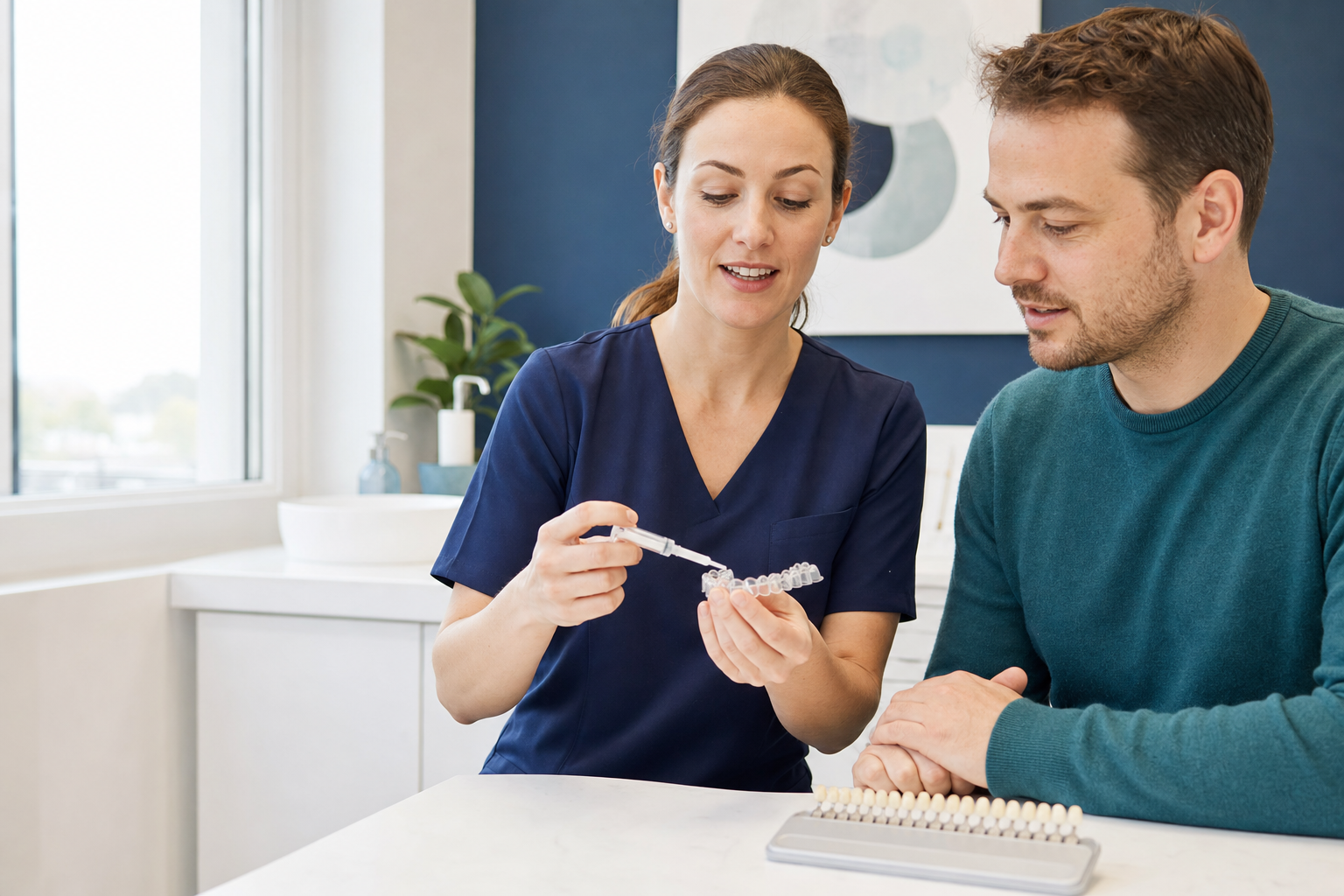
Safety note: Tooth whitening changes the colour of natural tooth tissue. It does not remove decay, treat gum disease or predictably lighten fillings, crowns, veneers or implants.
What is teeth whitening?
Teeth whitening, also called dental bleaching, uses peroxide-based agents to break down colour molecules within enamel and dentin. The result depends on the cause of discoloration, baseline shade, concentration, contact time and individual response. Professional options include dentist-supervised home trays, in-office treatment and combined protocols.
What causes tooth discoloration?
External stain can accumulate from tobacco, coffee, tea, wine and other pigments. Internal colour may relate to ageing, tooth development, trauma, medications, pulp changes or previous dental treatment. A single dark tooth requires diagnosis because internal bleaching or restorative treatment may be more appropriate than whitening the whole mouth.
Who needs an examination first?
A dentist should check for decay, cracks, leaking restorations, exposed roots, erosion, gum inflammation and sensitivity. Whitening gel can aggravate symptoms or enter an untreated cavity. Pregnancy, age, medical history and product regulation should be discussed. Whitening should not be used to disguise a dental problem.
Professional whitening options
Dentist-supervised home trays
Custom trays hold a prescribed carbamide- or hydrogen-peroxide gel against the teeth for a specified period. Gradual treatment allows dose and wearing time to be adjusted if sensitivity occurs. The tray should fit without flooding the gums.
In-office whitening
A higher-concentration gel is applied after soft tissues are protected. The clinician controls placement and exposure. Lights may be marketed as essential, but the bleaching agent and protocol drive the chemical effect; a light is not automatically evidence of a better or longer-lasting result.
Combined treatment
Some plans begin in the clinic and continue with trays. Greater treatment intensity can also increase sensitivity, so a combined protocol should have a patient-specific reason.
What result is realistic?
Natural teeth usually become lighter, but the endpoint cannot be guaranteed by a shade number. Yellow-brown discoloration often responds differently from grey, banded or developmental staining. Dehydration immediately after an appointment can make teeth look temporarily lighter; final evaluation should occur after rehydration.
Sensitivity and gum irritation
Short-term tooth sensitivity is the most common adverse effect. Gum irritation can occur when gel contacts soft tissue or trays overfill. Symptoms often resolve after exposure is reduced or stopped, but persistent or severe pain needs assessment. A 2024 review found that desensitising toothpastes helped in some protocols but not consistently across all concentrations and schedules.
Does a “white diet” matter?
Patients are often told to avoid all coloured food and drink. A 2024 systematic review and meta-analysis questioned whether a restrictive white diet is necessary for bleaching outcomes. Sensible stain control may be useful, but extreme dietary rules should not replace following the product protocol and maintaining oral hygiene.
Whitening before crowns or veneers
Existing restorations will not match a newly whitened tooth automatically. When planned, whitening is usually completed before final shade selection, followed by a stabilisation period chosen by the clinician. Restorations may then need polishing or replacement for colour harmony.
Risks of unregulated products
Unknown peroxide concentration, poor-fitting trays and acidic or abrasive products can irritate tissue or damage surfaces. Chlorine products, household chemicals and online “hacks” are unsafe. Product legality and permitted concentrations vary by country; treatment abroad should still include professional diagnosis and traceable materials.
Aftercare and maintenance
Brush twice daily with fluoride toothpaste, clean between teeth and reduce tobacco exposure. Colour rebound occurs as teeth rehydrate and new stains accumulate. Touch-up frequency should be based on need and sensitivity, not a fixed sales subscription. Keep trays clean and do not use leftover gel beyond its storage guidance.
Whitening toothpaste, polishing or bleaching?
These approaches solve different problems. Professional polishing can remove some surface deposits but does not bleach the internal colour of a tooth. Whitening toothpastes rely mainly on cleaning and stain removal; highly abrasive use can increase wear or sensitivity. Peroxide bleaching changes intrinsic colour. A clinician can identify whether stain, calculus, exposed dentin or internal discoloration is responsible before a product is selected.
Whitening a root-filled tooth
A tooth that darkens after pulp death or root-canal treatment may be treated from inside the pulp chamber in selected cases. The quality of the root filling, presence of decay, cracks and remaining restoration must be checked. A protective barrier is placed over the root filling before the bleaching agent. Internal bleaching has specific risks, including external cervical resorption, and should not be attempted with ordinary home products.
How a custom-tray plan is monitored
The dentist records a baseline shade and supplies the correct amount and concentration of gel. Patients should be shown how to load a small quantity in each tooth compartment, seat the tray and remove excess. Wearing time is product-specific; adding extra gel or sleeping in a product intended for shorter exposure does not create a controlled shortcut.
A review can check colour change, gum response and sensitivity. Treatment may pause, shorten or change concentration. Uneven initial response does not necessarily require higher doses: teeth can respond at different rates, and dehydration can distort chairside comparisons.
Managing sensitivity without hiding disease
Before whitening, exposed root surfaces, cracks and defective fillings should be identified. During treatment, clinicians may modify exposure, use fluoride or potassium-nitrate products, or build rest days into the schedule. Pain localised to one tooth, pain on biting, spontaneous throbbing or symptoms lasting after treatment stops should not be dismissed as routine whitening sensitivity.
How long should treatment take?
There is no universally correct number of sessions. In-office protocols may use one or more appointments; home-tray protocols commonly run over days or weeks. A 2024 meta-analysis found that shortening manufacturer-recommended home-gel exposure reduced sensitivity events but also reduced several measures of colour change. This illustrates a real trade-off rather than proof that longer or stronger is always better.
Planning whitening during dental travel
A same-trip whitening appointment is relatively simple only when the mouth is healthy and no immediate shade-matched restorations are planned. If veneers, bonding or crowns are part of the plan, sufficient time is needed for colour stabilisation and laboratory communication. Ask for the active ingredient, concentration, application time and manufacturer in writing. Clarify whether take-home trays are custom made and who will review unexpected sensitivity after departure.
Questions to ask a whitening provider
- What type of discoloration do I have?
- Which teeth and restorations will not change colour?
- What peroxide, concentration and exposure schedule are proposed?
- How will sensitivity be monitored and managed?
- Is the quoted result a target or a guarantee?
- What is the plan if a single tooth remains darker?
Frequently asked questions
Is whitening permanent?
No. The initial change may persist, but ageing and pigment exposure continue. Periodic, supervised touch-up may be considered.
Does whitening damage enamel?
Approved peroxide protocols used as directed are designed for dental use, but misuse, excessive exposure and unregulated products increase risk. Examination and supervision matter.
Can whitening treat a dead tooth?
A non-vital discoloured tooth may need internal bleaching after diagnosis and appropriate root treatment, not ordinary external trays alone.
Sources and clinical review references
- Butera A, et al. Effectiveness of professional tooth-whitening methods. Bioengineering. 2024.
- Cabral AEA, et al. Desensitising toothpastes after bleaching. Clin Oral Investig. 2024.
- de Melo PBG, et al. At-home gel exposure time, colour change and sensitivity. Clin Oral Investig. 2024.
- Martini EC, et al. Is a white diet necessary for tooth bleaching?. J Esthet Restor Dent. 2024.
Content status: editorial draft for review by a licensed dentist before publication. Last evidence check: 22 July 2026.