
 United Kingdom vs Turkey
 United States vs Turkey
 Germany vs Turkey
 France vs Turkey
 Spain vs Turkey
 Sweden vs Turkey
 Denmark vs Turkey
 Finland vs Turkey
 Ireland vs Turkey
 Netherlands vs Turkey
 Norway vs Turkey
 Australia vs Turkey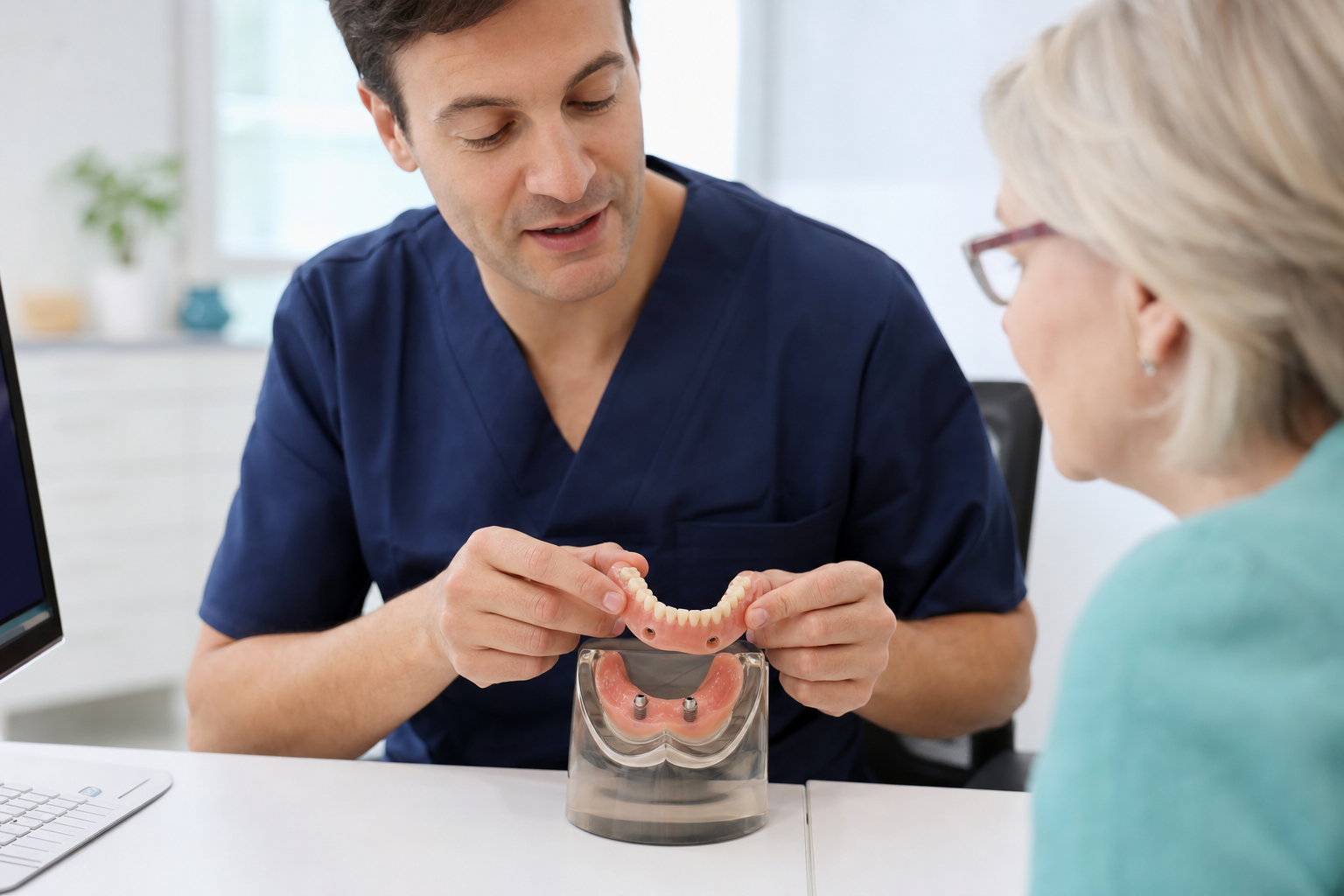
Clinical scope: “Implant-supported denture” often describes a removable implant overdenture, although some clinics use it for a fixed full-arch bridge. This guide focuses on the removable prosthesis that the patient takes out for cleaning.
What is an implant overdenture?
An implant overdenture is a removable denture retained or supported by implants through attachments. The implants improve resistance to lifting and lateral movement, while the denture may still receive some support from the gum and ridge. It is removed daily for cleaning. This differs from a screw-retained fixed complete bridge that only a clinician removes.
Retained versus supported
Some overdentures are mainly tissue-supported and use implants for retention; others gain substantial support from a bar or multiple implants. The distinction affects movement, tissue loading, space, cost and maintenance. Advertising may call either design “snap-in teeth,” so the written plan should specify implant number, attachment type and expected tissue contact.
Who may benefit?
It may help an edentulous patient whose conventional denture moves, causes soreness or limits confidence and chewing. It can also restore lip and facial support more readily than some fixed bridges because the flange replaces lost tissue volume. Candidates need adequate health, anatomy or a graft plan, manual ability or caregiver support and realistic acceptance of a removable appliance.
Conventional denture alternative
A well-made conventional denture remains a valid non-surgical choice, particularly when medical risk, cost or anatomy makes implants unsuitable. It can restore large tissue deficits and is easy to modify. Lower dentures are often less stable because of tongue movement and limited bearing area; implant retention may provide a particularly meaningful improvement in the mandible.
Fixed full-arch alternative
A fixed bridge may feel more like fixed teeth and often has greater stability, but it needs sufficient restorative space, favourable implant distribution and meticulous cleaning beneath it. It usually costs more and can be harder to repair or clean. An overdenture offers removability and flange support, but attachments wear and the denture still needs periodic relining or replacement.
How many implants in the lower jaw?
Two implants in the front mandible are a widely used approach, while one midline implant is an evidence-supported option in selected patients and markets. Recent reviews report similar implant survival in some comparisons but more denture fractures, remakes or housing reattachment with single-implant designs. More implants may support bars or reduce movement, yet add surgery and cost.
How many implants in the upper jaw?
The maxilla has different bone quality and denture mechanics. Designs commonly use more implants and may splint them with a bar. Removing palatal coverage can improve taste and comfort but increases reliance on implant support and distribution. Implant number cannot be copied directly from the mandible; sinus anatomy, ridge form, opposing forces and prosthetic space require separate planning.
Diagnostic assessment
Examination evaluates the existing denture, smile, speech, lip support, ridge, mucosa, jaw relationship, opening and hygiene ability. Scans or impressions record anatomy and bite. CBCT may be indicated for implant planning. The existing denture can serve as a diagnostic template if its tooth position and facial support are acceptable; otherwise the tooth setup should be corrected first.
Restorative space
Attachments, housings, acrylic thickness and teeth require vertical room. Insufficient space weakens the denture or overopens the bite. Excessive space may produce bulky contours. The team measures from implant platform to planned tooth and tissue surfaces before surgery. Bone reduction solely to fit a preferred attachment should be weighed against preserving anatomy and choosing a different design.
Individual stud attachments
Low-profile attachments, ball attachments and related studs connect each implant to a replaceable insert in the denture. They can be economical and easy to clean around. Parallelism, tissue thickness and restorative space influence selection. Retentive inserts wear and are expected maintenance items; different colours or grades provide different retention but should not be made excessively tight.
Locator-type attachments
Locator-style systems are widely used because of low vertical height and replaceable nylon or polymer inserts. They can accommodate limited divergence within system specifications. Reviews report good satisfaction, but insert wear, housing loosening and maintenance occur. “Locator” is sometimes used generically; actual brand, abutment height and insert type should be recorded for future service.
Ball and O-ring attachments
Ball abutments engage resilient rings in denture housings. They are relatively straightforward and can provide useful retention when implants are suitably positioned. Rings lose elasticity and need replacement. Divergent implants can accelerate wear or prevent a common path of insertion. A worn attachment should be serviced rather than compensated for with uncontrolled chairside material.
Bar attachments
A bar joins implants and the denture clips over it. It can splint implants, control rotation and provide strong retention, but requires more vertical space and careful cleaning beneath the bar. Clip wear, bar fracture, screw loosening and tissue overgrowth or inflammation can occur. The bar must be passively fitting and shaped to allow brushes to pass.
Telescopic and magnetic attachments
Telescopic crowns can provide support and a defined path but require technical precision and space. Magnetic attachments are easy to seat for some patients with limited dexterity, yet generally offer less resistance to lateral displacement and can corrode or lose function depending on design. Evidence does not identify one attachment as best for every patient.
Choosing the attachment
The choice balances implant number and angle, restorative space, ridge support, desired retention, hygiene, hand strength, repair access and local component availability. Bar systems may offer high retention; low-profile studs simplify hygiene and cost. Patient satisfaction is influenced by the complete denture fit and expectations, not attachment brand alone.
Implant placement and healing
Implants are placed in planned positions, often in the anterior jaw where anatomy and bone permit. They may heal unloaded beneath the denture or receive early attachments under a validated protocol. The existing denture must be relieved so it does not press on surgical sites. Soft liners may improve comfort but require hygiene and replacement.
Immediate loading
Selected overdentures can be retained soon after placement when implant stability and protocol allow. Early function does not shorten biological integration. Excess movement or a poorly relieved denture can overload implants. The team needs a delayed-loading contingency, and the patient must follow diet and insertion instructions while attachments and tissue settle.
Making the overdenture
Impressions or digital records capture implant and tissue positions. Jaw relation, tooth setup, smile and speech are tried in before final processing. A metal framework may reinforce the acrylic, especially around housings where space is thin. Attachments can be incorporated in the laboratory or picked up chairside; either method requires complete seating and controlled resin.
Insertion and removal
The patient learns to align the denture without biting it forcefully into place. Removal should use balanced finger pressure rather than levering one side. Excessive initial retention can be reduced. A patient with arthritis, neuropathy or limited vision should demonstrate handling before the final design is accepted; caregiver training may be necessary.
Will it move?
A removable overdenture may rotate slightly, particularly when it remains tissue-supported behind anterior implants. This is not necessarily failure. The amount depends on attachment design, ridge form, fit and biting forces. A bar or additional implants can reduce movement but may complicate hygiene. Expectations should be tested with a provisional or existing denture discussion.
Chewing and speech
Improved retention can increase confidence and chewing ability compared with an unstable conventional lower denture, and systematic reviews report better satisfaction and oral-health-related quality of life. Adaptation is still required. Tooth position, tongue space and occlusal balance influence speech and function more than attachment strength alone.
Cleaning the implants
Remove the denture and brush attachment abutments and surrounding tissue at least daily with a soft brush. Interdental brushes or floss may be needed beneath bars. Deposits around abutments can cause bleeding and odour. Abrasive paste and metal instruments may damage components. The clinician should select aids that match the patient’s dexterity.
Cleaning the denture
Brush all surfaces with a denture brush and appropriate non-abrasive cleaner. Clean inside attachment housings without dislodging inserts. Unless specifically advised otherwise, leave the denture out during sleep so tissues rest, and store it as directed. Very hot water can distort acrylic. Cleansers must be compatible with metal and attachment components.
Insert replacement
Polymer inserts and O-rings are consumable parts. Loss of retention, uneven seating or repeated dislodgement may signal wear, implant divergence, housing movement or denture misfit. Replacement intervals vary widely with use and design. The clinic should inspect the underlying cause before repeatedly fitting stronger inserts that may increase stress or make removal difficult.
Relining and ridge change
The jaw ridge continues to remodel beneath a tissue-supported overdenture. Loss of fit increases rocking, sore spots and attachment load. A reline resurfaces the denture to match current tissue; a rebase replaces most acrylic while retaining teeth when appropriate. Attachments do not prevent ridge change, so periodic fit assessment remains essential.
Denture fracture
Fracture often occurs around housings where acrylic is thin, especially with a single midline implant or inadequate restorative space. Reinforcement, corrected fit and balanced occlusion may reduce recurrence. Repairing only the crack without addressing rocking, insert position or material thickness can lead to another fracture. A temporary denture plan is useful during laboratory repair.
Attachment or screw complications
Housings can debond, clips can wear, bars or screws can loosen and abutments can fracture. Stop using a denture that suddenly rocks or will not seat; forcing it may damage the component. Bring any loose part to the appointment. Proprietary drivers and replacement parts make an implant passport particularly important.
Biological complications
Plaque-associated mucositis can develop around attachments, and peri-implantitis includes progressive bone loss. A denture flange may hide inflammation. Reviews should include removal of the prosthesis, probing, tissue inspection and radiographs when indicated. Smoking, previous periodontitis, diabetes control and poor hygiene influence risk independently of attachment choice.
Facial support and aesthetics
The removable flange can restore lost lip support and mask ridge defects without very long teeth. The tooth setup should be tried in for smile, midline, phonetics and facial profile. Overbuilding the flange can make lips look strained, while under-support can age the face. These decisions are easier to test before acrylic is processed.
Longevity
The implants, attachments and denture have different service lives. An implant can remain integrated while inserts are replaced many times and the denture is relined or remade. Published satisfaction is generally favourable, but maintenance is part of the treatment model. Budgeting only for surgery creates unrealistic expectations.
Treatment abroad
Request implant and attachment brands, abutment heights, insert codes, torque values, denture material and reinforcement details. Confirm where inserts and clips can be replaced at home. Ask who manages pressure sores or a fractured denture immediately after return. A spare conventional denture may provide resilience during repair.
Questions to ask
- Is the denture primarily implant- or tissue-supported?
- Why this number of implants and attachment type?
- How often are inserts, clips and relines expected?
- Can I insert, remove and clean it independently?
- Will the palate be covered?
- Which parts are available in my home country?
Frequently asked questions
Does it come out at night?
Usually yes. Most removable overdentures are removed for cleaning and tissue rest according to the clinician’s instructions.
Is it the same as All-on-4?
No. All-on-4 commonly describes a fixed full-arch concept, while an overdenture is removable by the patient.
Will I need denture adhesive?
Often not for retention, but tissue support and fit still matter. Adhesive should not mask a loose, rocking or damaged attachment system.
Sources and clinical review references
- Attachment systems for mandibular implant overdentures: systematic review and meta-analysis.
- Koyama et al. Single versus two-implant mandibular overdentures.
- Lemos et al. Effectiveness of one- or two-implant mandibular overdentures: umbrella review.
- Oral-health-related quality of life and satisfaction with implant overdentures.
- Chaware and Thakkar. Overdenture attachment systems.
Editorial review note: Evidence reviewed 22 July 2026. This educational draft requires named dental-clinician review and jurisdiction-specific checking before indexation.