
 United Kingdom vs Turkey
 United States vs Turkey
 Germany vs Turkey
 France vs Turkey
 Spain vs Turkey
 Sweden vs Turkey
 Denmark vs Turkey
 Finland vs Turkey
 Ireland vs Turkey
 Netherlands vs Turkey
 Norway vs Turkey
 Australia vs Turkey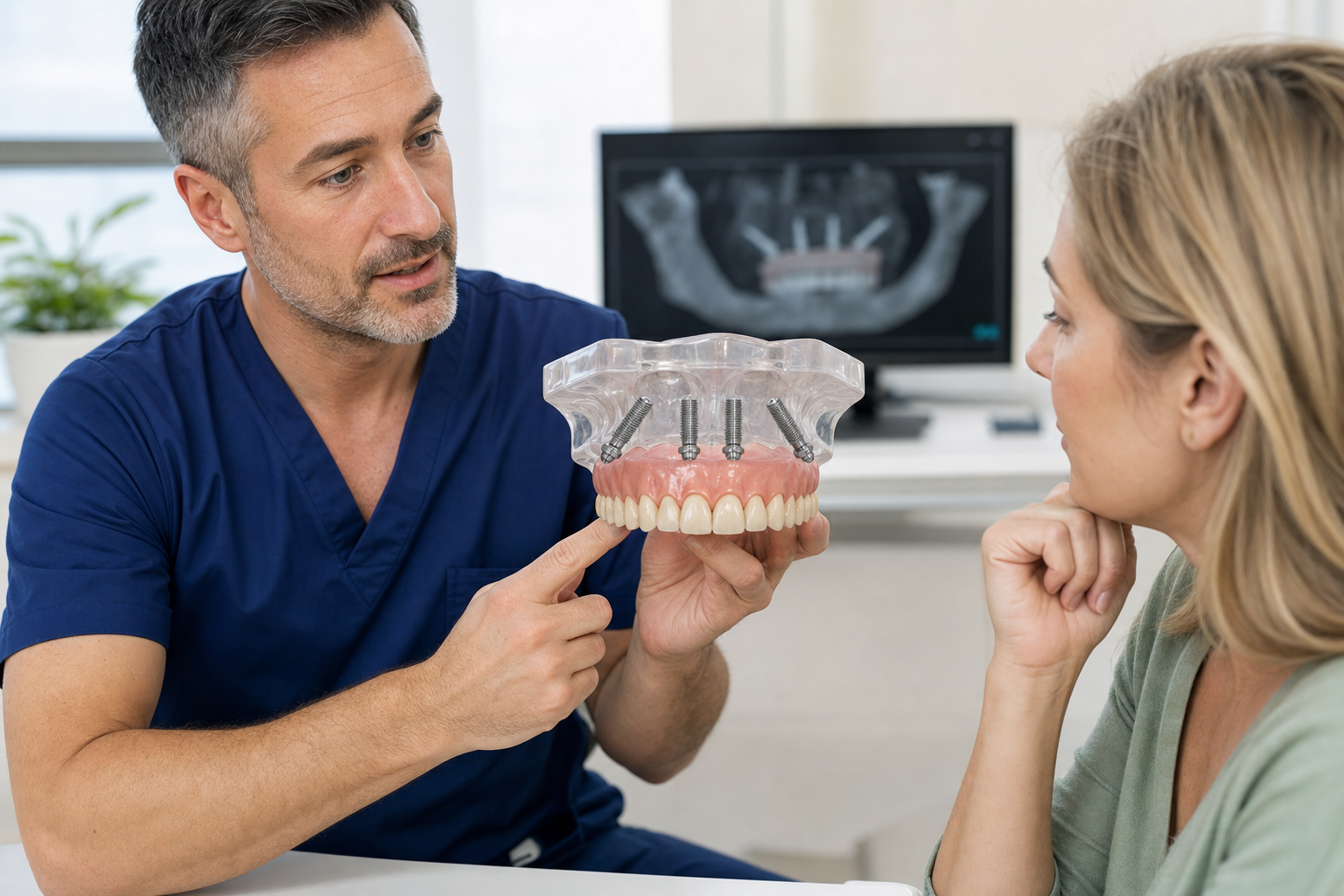
Clinical scope: All-on-4 describes a fixed complete-arch concept supported by four implants, commonly with two posterior implants tilted. It is not a universal brand-independent promise of same-day permanent teeth, nor is every four-implant bridge identical.
What is All-on-4?
All-on-4 replaces all teeth in one jaw with a fixed bridge supported by four implants. Two anterior implants are commonly placed relatively upright and two posterior implants may be tilted to use available bone, avoid anatomy and shorten the prosthetic cantilever. Multi-unit abutments create a shared platform for a screw-retained provisional and later definitive bridge.
Concept versus brand
The term originated as a defined treatment concept but is now used loosely for many four-implant full-arch systems. Implant design, angulation, components, loading criteria, surgical guide and prosthesis vary. Patients should receive the exact manufacturer and protocol rather than assuming that the familiar name guarantees identical evidence, training or aftercare.
Why use only four implants?
Four strategically distributed implants can support a complete arch while reducing surgery and avoiding some grafts. The approach may help when posterior bone is limited by the sinus or mandibular nerve. It is not chosen merely to minimise price. With only four supports, position, primary stability, passive fit and the contingency for one failed implant become especially important.
Who may be considered?
Candidates may be fully edentulous or have a failing dentition that cannot predictably be retained. They need sufficient bone in planned zones, controlled medical and periodontal risk, acceptable restorative space and the ability to maintain a fixed bridge. High smile line, extreme bone loss, heavy bruxism or poor hygiene may change the design or favour a removable solution.
Are the remaining teeth hopeless?
All teeth should be assessed individually for periodontal support, cracks, decay, endodontic prognosis and restorability. Extraction is irreversible. A treatment package should not define prognosis. Retaining strategic teeth, staged treatment or an overdenture may preserve options. The patient should understand why each tooth cannot contribute predictably before agreeing to clearance.
Upper versus lower jaw
The upper jaw often has softer bone, sinus limitations and different facial-support needs. The lower jaw has nerve anatomy, tongue movement and typically denser anterior bone. A four-implant plan cannot be copied between arches. Implant length, spread, tilt and immediate-loading stability are assessed separately, even when both jaws are treated together.
Diagnostic records
Records include medical history, periodontal charting, photographs, facial and intraoral scans or impressions, jaw relation and CBCT where justified. A tooth setup establishes appearance, speech, lip support and restorative space. Bone reduction and implant positions are planned from this setup. Digital planning assists but scan matching and guide seating introduce deviation.
The two tilted posterior implants
Tilting can move the implant head posteriorly while keeping the apex within available anterior bone, improving anterior-posterior spread and reducing cantilever. Angled multi-unit abutments correct the restorative path. Systematic reviews report predictable survival for tilted and axial implants in selected full-arch cases, although some analyses find differences in marginal bone measures.
Tilt is not random
The angle is selected around bone envelope, anatomy, drill access and prosthetic screw channels. Excessive tilt can complicate hygiene, create thin facial bone or require high corrective abutments. The aim is a safer restorative distribution, not simply avoiding grafting. Three-dimensional verification and system-specific component limits are required.
Bone reduction
Bone may be levelled to remove diseased sockets, create prosthetic space and hide the pink-to-natural tissue transition. Reduction is irreversible and can affect future alternatives. A guide based on the approved tooth setup should define the amount. Removing a standard depth for every patient sacrifices anatomy for convenience and may impair lip support.
Guided or freehand placement
Static guides, navigation or conventional surgery may be used. A guide can coordinate implants and a prefabricated temporary bridge, but it does not guarantee exact placement. Mucosa-supported full-arch guides require stable seating and often fixation pins. The surgeon must be ready to raise a flap, change implant dimensions or abandon the prefabricated bridge when safety requires.
Immediate loading
Many All-on-4 treatments provide fixed provisional teeth within a day. Immediate loading requires adequate stability in all supporting implants, a passively fitting splinted provisional and controlled bite. It does not mean the implants are healed. If one implant lacks stability, it may be excluded, replaced or left unloaded, and a removable temporary may be needed.
Primary stability
Insertion torque, resonance frequency, bone quality and clinical judgement inform the loading decision. A high number alone does not prove safe stability, and excessive compression can damage bone. Four implants must work as a coordinated support system. The patient should know the clinic’s threshold and contingency before surgery, not after the provisional plan fails.
Immediate provisional bridge
The first bridge is commonly milled or converted in PMMA or acrylic. It tests tooth position, smile, speech and bite while integration occurs. It can fracture, especially around thin cylinders or long cantilevers. Prompt repair protects implants. The patient follows a soft diet and avoids using the provisional as if it were the definitive arch.
Passive fit
The bridge must seat across four restorative platforms without being pulled down by screws. A verification jig, clinical tests and radiographs may be used. Tightening an inaccurate framework creates strain and increases screw or fracture risk. A digital workflow still needs verification because scan, guide, conversion and laboratory errors can accumulate.
Cantilever control
Posterior teeth beyond the tilted implants act as levers. Tilting is intended partly to reduce that extension, but it does not remove it. Cantilever length is selected from implant spread, arch, framework, opposing teeth and bruxism. Adding extra molars for appearance can increase mechanical risk without providing meaningful function.
Definitive bridge options
Choices include titanium-acrylic or composite hybrids, metal-ceramic, monolithic zirconia and combinations with individual crowns. Acrylic designs are lighter and repairable but wear; zirconia is strong and colour stable but harder to repair. Available restorative space, opposing material and service network matter more than a universal “premium” ranking.
Smile and transition line
The junction between artificial pink material and natural tissue should be hidden during normal smiling or blended acceptably. A high smile line may reveal an artificial border. The provisional tests tooth length, gum display and lip support. Excessive bone reduction to hide the junction must be weighed against permanent loss of anatomy.
Speech
Anterior tooth position, palatal contour and the gap beneath the bridge affect s, f and t sounds. Small changes may improve with adaptation; large errors need adjustment. Speech should be evaluated in normal conversation with the provisional. A definitive zirconia arch is much harder to reshape or add to than a polymer temporary.
Cleaning
A fixed All-on-4 bridge is cleaned underneath every day with floss threaders, interdental brushes and/or a water irrigator as instructed. The underside must permit access around each implant. A seamless-looking contour that traps plaque is not a biological advantage. The patient should demonstrate cleaning before final manufacture.
Professional maintenance
Reviews assess plaque, bleeding, probing depths, suppuration, radiographic changes where indicated, screw stability, material wear and bite. Evidence does not establish one universal schedule for removing full arches. Risk-based removal may improve access, but repeated screw manipulation also carries cost and component wear.
Biological complications
Mucositis and peri-implantitis can affect tilted and axial implants. Previous periodontitis, smoking, diabetes control, plaque and inaccessible contours matter. An implant can survive while losing bone or requiring treatment. Marketing survival percentages should not be interpreted as the proportion of patients who remain free of all inflammation and repairs.
Technical complications
Provisional fracture, acrylic tooth wear, ceramic chipping, access-filling loss, screw loosening and framework fracture can occur. With four supports, movement at one interface deserves prompt investigation. Repairability should be designed from the start, and a temporary solution should be available while the definitive prosthesis is in the laboratory.
What if one implant fails?
The original four-implant distribution may no longer safely support the bridge. The prosthesis is removed and remaining stability assessed. Options include replacement, adding an implant, redesigning or using a removable temporary. Continued loading on three implants is not automatically acceptable. The contingency and financial responsibility should be discussed before treatment.
All-on-4 versus All-on-6
More implants may provide redundancy or enable different prosthetic segmentation, but systematic reviews have not shown implant number alone to determine survival or complications across all cases. Six implants require adequate bone and spacing. Four may reduce surgery yet leaves less redundancy. Anatomy and restorative design, not a number hierarchy, should decide.
All-on-4 versus overdenture
An overdenture is removable, often easier to clean and better able to provide lip support. All-on-4 is fixed for the patient and may feel more stable. Fixed contours can be difficult for patients with limited dexterity. Patient-reported preferences, facial support, cost and maintenance should be considered alongside the desire for non-removable teeth.
Planning for ageing and reduced dexterity
A full-arch bridge may remain in service while the patient’s vision, hand strength or ability to attend appointments changes. The initial plan should consider whether a caregiver could clean beneath the prosthesis and whether the bridge can be converted or replaced with a removable design later. Extremely narrow hygiene tunnels may be manageable at age fifty but unrealistic after illness or neurological decline.
Maintenance arrangements should also survive relocation. Component records, a retrievable screw design and locally available drivers make future care more resilient. Long-term success is therefore partly an accessibility problem: the patient needs both physical access beneath the bridge and practical access to clinicians capable of servicing its implant system.
Evidence and limitations
Reviews of tilted and axial full-arch implants report high implant and prosthesis survival over multi-year follow-up, but study protocols, definitions and risk of bias vary. Loading reviews also report favourable outcomes with substantial heterogeneity. Evidence supports All-on-4 as a valid selected option, not as a guarantee or universal standard.
Treatment abroad
Request implant and multi-unit brands, angles, platforms, screw references, torque values, provisional and definitive materials, CAD files and baseline radiographs. Clarify who manages a fracture or failed integration after return. A proprietary component unavailable locally can turn a simple loose screw into an international repair.
Questions to ask
- Why are all remaining teeth non-restorable?
- Why are four implants appropriate for this jaw?
- What loading criteria and backup are used?
- Where will the transition line show?
- How long is the planned cantilever?
- What happens if one implant fails?
Frequently asked questions
Are the same-day teeth permanent?
Usually no. They are a provisional bridge used during integration and design testing.
Do tilted implants fail more?
Systematic reviews report comparable survival in selected cases, though bone-level findings vary and correct planning remains essential.
Can All-on-4 be removed?
The patient does not remove it, but a clinician can normally unscrew it for service.
Sources and clinical review references
- Del Fabbro et al. Tilted and axial implants in fixed full-arch rehabilitation.
- Mehta et al. Tilted versus axial implants in the edentulous maxilla.
- Gallardo et al. Complete-arch outcomes according to loading time.
- Optimal implant number for complete-arch prostheses.
Editorial review note: Evidence reviewed 22 July 2026. Named clinician review is required before indexation.