
 United Kingdom vs Turkey
 United States vs Turkey
 Germany vs Turkey
 France vs Turkey
 Spain vs Turkey
 Sweden vs Turkey
 Denmark vs Turkey
 Finland vs Turkey
 Ireland vs Turkey
 Netherlands vs Turkey
 Norway vs Turkey
 Australia vs Turkey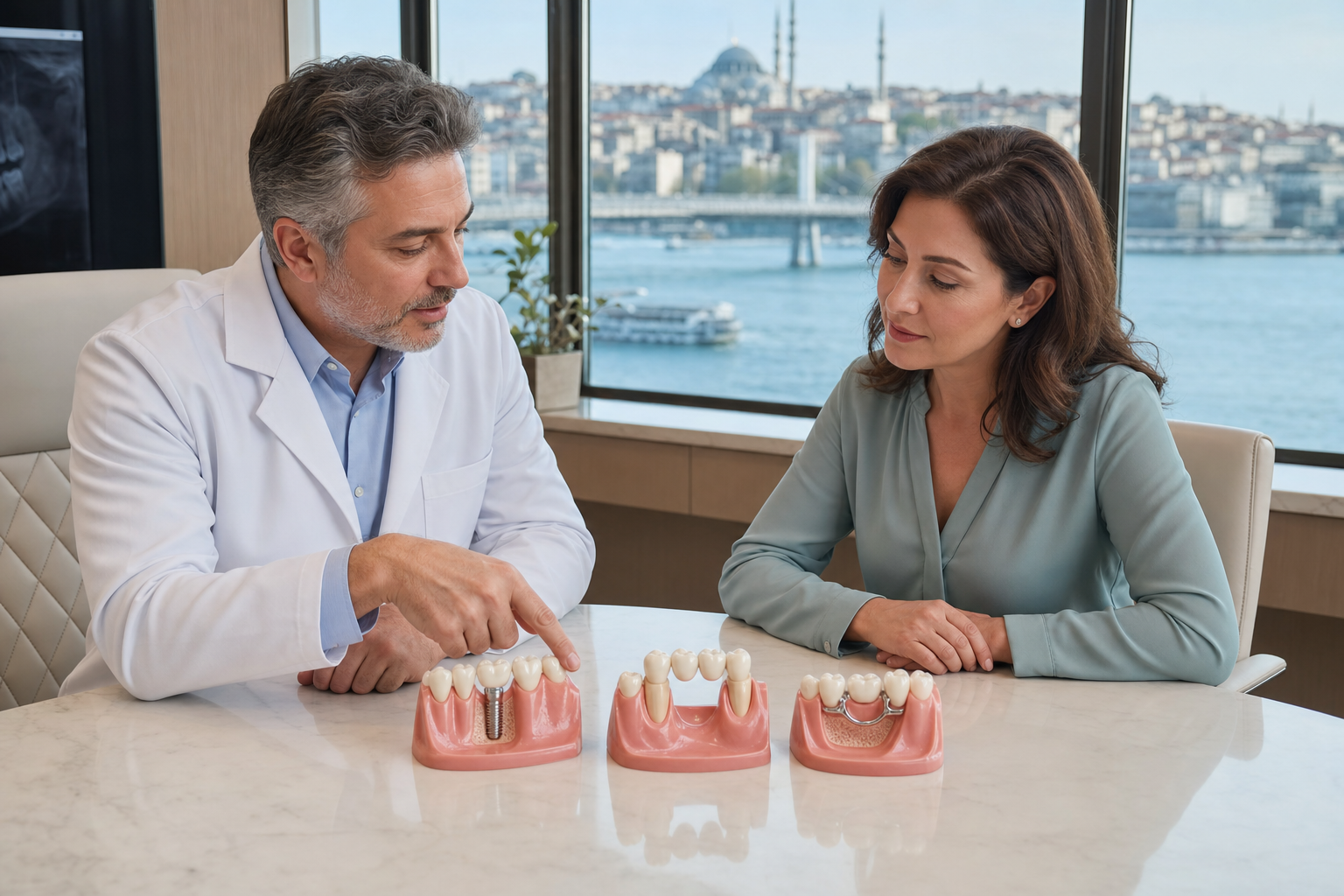
Clinical review required: Missing-tooth management depends on the cause, number and position of spaces, remaining teeth, bone and gum health, bite, growth, medical risk, budget and patient priorities. Replacement is not automatically necessary for every space.
What does missing teeth mean?
Missing teeth can describe one absent tooth, several spaces or complete loss of all teeth in one or both jaws. A tooth may never have developed, may have been extracted, or may be present but impacted beneath the gum. The effects vary: a missing front tooth can strongly affect appearance and speech, while posterior tooth loss may alter chewing or have little perceived impact.
Common causes
Decay, periodontitis, fracture, failed root-canal treatment, trauma and unsuccessful restorations are common acquired causes. Some teeth are congenitally absent, particularly certain lateral incisors and premolars. Impacted teeth, tumours, cysts or previous surgery can also create an apparent gap. Identifying the cause helps protect the remaining dentition and guides timing.
Why assessment comes before replacement
A replacement placed into uncontrolled disease is vulnerable to the same environment that contributed to tooth loss. Examination should assess decay, gum and implant health, plaque control, bite, tooth prognosis, available space, smile line and soft tissue. Relevant radiographs, and CBCT only when justified, help evaluate roots, impacted teeth, bone and anatomy.
Do all missing teeth need replacement?
No. Some stable spaces can be monitored when appearance, speech, comfort and function are acceptable. A shortened dental arch with adequate functional tooth contacts may be reasonable for selected adults. Replacement becomes more compelling when a space affects function or confidence, neighbouring teeth drift, an opposing tooth over-erupts, or the treatment also protects compromised teeth.
What happens if a space is left?
Possible changes include tipping or rotation of nearby teeth, over-eruption of the opposing tooth, food trapping and local bone remodelling. These changes are not inevitable or equally important in every patient. Missing teeth do not automatically cause jaw-joint disorders or facial collapse. Monitoring should focus on documented change and patient-centred impact.
Single-tooth replacement options
Options include an implant-supported crown, a conventional tooth-supported bridge, a resin-bonded bridge and a removable partial denture. Orthodontic space closure or deliberate monitoring may also be appropriate. Each choice differs in surgery, tooth preparation, maintenance, time, cost, repairability and dependence on neighbouring teeth.
Dental implant
An implant can support a crown without preparing adjacent teeth. Suitability depends on growth completion, bone, gum phenotype, anatomical structures, hygiene, smoking, health and space. Treatment may require grafting and several stages. Implants cannot decay, but peri-implant inflammation, bone loss and mechanical complications remain possible.
Conventional dental bridge
A bridge uses neighbouring teeth as supports. It may be efficient when those teeth already need crowns or substantial restoration. Preparing intact teeth is a major trade-off, and decay or root problems in an abutment can compromise the bridge. Cleaning beneath the replacement tooth is essential.
Resin-bonded bridge
A resin-bonded or Maryland bridge uses a wing bonded mainly to enamel and can preserve tooth tissue. It is often considered for selected front-tooth spaces and younger patients. Bite, enamel availability, wing design and space determine suitability. Debonding is possible, but repair can be relatively conservative.
Removable partial denture
A removable denture can replace several teeth without one implant per space and can restore lost gum volume. It is taken out for cleaning and may use clasps, rests or precision attachments. Adaptation, movement, speech, bulk and maintenance vary. Design should protect remaining teeth rather than simply fill gaps.
Multiple missing teeth
Several spaces may be restored with implant-supported bridges, tooth-supported bridges, removable partial dentures or combinations. Strategic implants can sometimes reduce the size or movement of a removable prosthesis. Planning considers the whole arch, not one gap at a time, so support and cleaning access remain balanced.
Complete tooth loss
Complete dentures, implant-retained overdentures and fixed full-arch implant prostheses are principal options. Overdentures can improve retention, especially in the lower jaw, but remain removable. Fixed bridges feel different and require sufficient implants, hygiene access and prosthetic maintenance. No option recreates natural teeth without limitations.
Bone loss after extraction
The ridge commonly changes after a tooth is removed. Bone loss can affect implant position and the appearance of pontics or dentures. Socket preservation may reduce some dimensional change but cannot prevent all remodelling. Later grafting may be possible; the need depends on the chosen replacement, not simply the age of the space.
Missing front teeth
Front-tooth planning must coordinate tooth proportions, gum levels, papillae, lip movement, speech and bone. A technically integrated implant can still look asymmetric if soft tissue is deficient. Temporary teeth help shape tissue and test appearance. High-smile-line cases need especially clear consent about aesthetic limitations.
Missing molars
A missing molar may reduce chewing support, but replacement is not automatic. Consider the number and distribution of remaining contacts, the opposing tooth, drift, chewing preference and patient goals. A distal-extension denture, implant or monitoring can each be reasonable in different circumstances.
Young patients and congenitally missing teeth
Implants are generally delayed until facial growth is sufficiently complete because they do not move with growing teeth and jaws. Interim resin-bonded bridges, removable teeth or orthodontic space management may be used. A coordinated orthodontic, restorative and periodontal plan should decide between space closure and future replacement.
Treatment sequence
Control pain and active disease first. Stabilise decay and gums, confirm which teeth are maintainable, then plan orthodontics, grafting or implants where required. Provisional restorations can test bite and appearance. Final treatment should be followed by a documented maintenance schedule.
Risks and maintenance
All replacements require upkeep. Bridges and dentures can increase plaque-retentive areas; implants can develop mucositis, peri-implantitis or component problems. Natural supporting teeth remain susceptible to decay, root fracture and gum disease. Daily access, professional monitoring and repair plans matter as much as the initial appearance.
Treatment abroad
Request diagnosis, tooth prognosis, full option comparison, implant and component records, graft details, laboratory material, scans and maintenance requirements. Clarify who manages provisional failure, implant complications and incompatible parts after returning home. A warranty rarely covers travel or biological complications.
When to seek urgent care
A long-standing gap is not normally an emergency. Seek urgent assessment after trauma with a knocked-out permanent tooth, facial swelling, fever, uncontrolled bleeding or breathing and swallowing difficulty. A knocked-out adult tooth is time-sensitive: handle it by the crown, avoid scrubbing the root and obtain emergency dental care immediately.
Questions to ask
- Does this space need treatment now?
- Which options preserve the most healthy tissue?
- Will grafting or orthodontics be required?
- How will I clean and maintain the result?
- What can be repaired if a component fails?
- What happens if I choose monitoring?
Frequently asked questions
Is an implant always best?
No. It avoids preparation of adjacent teeth but adds surgery, healing time and implant-specific risks. A bridge, denture, orthodontic closure or monitoring may suit another case better.
Will teeth move into the gap?
Movement can occur, but its amount and clinical importance vary. Serial records help distinguish possibility from actual progression.
Can missing teeth cause bone loss?
The ridge normally remodels after extraction. The amount varies and does not always prevent later treatment.
How long does replacement take?
It ranges from short appointments for some removable or bonded options to many months when orthodontics, grafting or implant integration is required.
Sources and clinical review references
- Tooth loss, edentulism and quality of life.
- Quality of life after prosthodontic treatment for partial tooth loss.
- Shortened dental arch and prosthetic effects on quality of life.
- Prosthetic rehabilitation of partially dentate or edentulous patients.
Editorial review note: Evidence reviewed 22 July 2026. Named clinician review is required before indexation.