
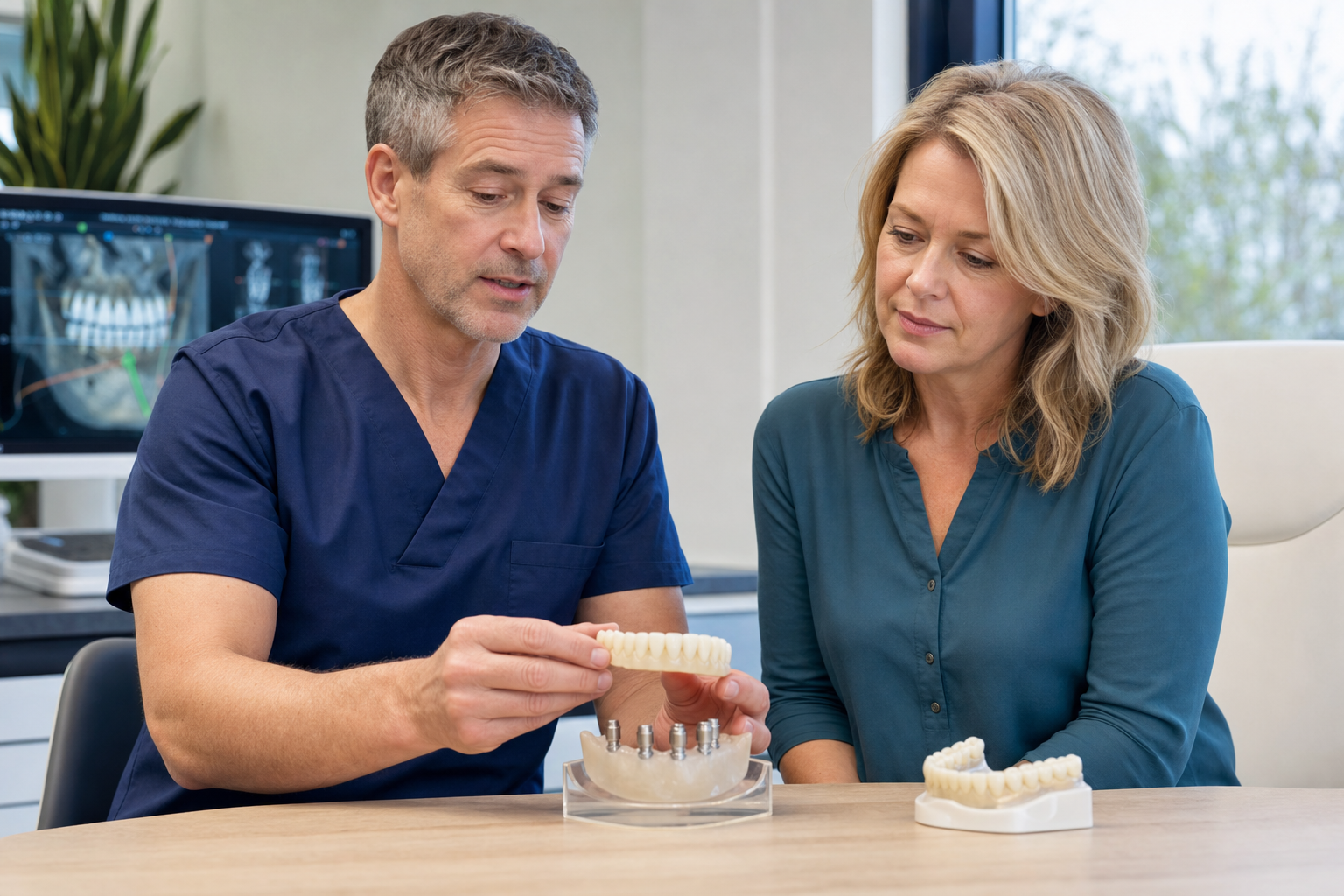
Clinical scope: “Teeth in a Day” usually means implant placement and connection of a fixed or removable provisional within about 24 hours. It does not mean final healing, guaranteed immediate loading or a definitive lifetime prosthesis.
What does Teeth in a Day mean?
The phrase describes a compressed workflow in which failing teeth may be removed, implants placed and temporary teeth delivered on the same day. It can refer to one tooth or a complete arch, although this guide focuses on full-arch fixed provisional treatment. The exact promise should state surgery, loading and restoration timing separately.
Placement, restoration and loading are different
Immediate placement means an implant enters a fresh extraction socket. Immediate restoration means a temporary tooth is connected quickly. Immediate loading means that restoration transmits functional force. These can occur together or separately. A provisional may be deliberately kept out of contact, and an implant placed immediately may be left unloaded.
The same-day teeth are usually provisional
Polymer temporary teeth protect appearance and provide controlled function while implants integrate and tissues remodel. They are easier to adjust and repair than the definitive arch. Final zirconia, metal-ceramic or titanium-hybrid teeth usually follow later verification. Calling the provisional “permanent” hides an important clinical stage and can distort cost comparisons.
Who may be considered?
Candidates need adequate bone and primary implant stability, a prosthetically workable distribution, manageable health risks and commitment to diet and hygiene. Active uncontrolled infection, severe parafunction, inability to follow instructions or anatomy that needs major grafting may favour staged loading. The decision is confirmed during surgery, not guaranteed solely from a scan.
Diagnosis before speed
Tooth prognosis, periodontal disease, medical history, smoking, diabetes control, bite and aesthetic risk are assessed before scheduling. Photographs, scans or impressions and CBCT where justified support planning. A rapid workflow should result from detailed preparation. It should not compress diagnosis into a travel-day consultation followed immediately by irreversible extraction.
Can teeth be saved?
“Teeth in a Day” marketing can create pressure to remove an entire arch. Each tooth should be assessed for cracks, decay, support and restorability. Retaining strategic teeth or using staged implants may be more conservative. The patient should receive a reasoned prognosis before consent, especially when extraction makes the advertised timeline possible.
Digital planning
Facial and intraoral scans, photographs, jaw records and CBCT are merged to position virtual teeth and implants. A surgical guide and provisional may be made in advance. Every transfer step has error: scan artefact, matching, guide seating, drill tolerance and implant position. The prefabricated bridge must be verified and may require conversion or remake.
Conventional conversion workflow
An existing or laboratory-made denture can be converted chairside after implant placement by attaching it to temporary cylinders. The team relieves acrylic, captures cylinder positions with resin and finishes the bridge. This accommodates actual implant placement but requires careful isolation and sufficient material. Polymer debris and incomplete seating must be controlled.
Photogrammetry and digital capture
Photogrammetry may record implant positions after surgery for rapid milling. It can improve full-arch coordinate capture but does not record tissue, bite and aesthetics by itself. Those datasets must be combined and verified. A digital device is a measurement tool; passive fit and occlusion remain clinical responsibilities.
Primary stability
Immediate loading relies on mechanical engagement at placement. Insertion torque, resonance frequency, bone quality, implant design and distribution inform the decision. No single threshold guarantees integration. Excessive torque can damage bone. A weak implant may be left out of the provisional, replaced, or allowed to heal without load.
Cross-arch splinting
A rigid provisional connects multiple implants so forces are shared and micromovement limited. This benefit depends on passive fit and adequate framework bulk. A cracked provisional loses splinting and can expose individual implants to harmful movement. Patients should report any click, crack or looseness immediately rather than wait for a scheduled review.
Immediate extraction and implant placement
Implants can sometimes enter extraction sockets during the same surgery. Socket walls, infection control and primary stability are assessed. Placement should follow the final prosthesis rather than simply the socket centre. Gaps may be grafted. Immediate placement does not prevent ridge remodelling or guarantee that every extraction site can receive an implant.
Bone reduction
Bone may be reduced to create restorative room and hide the tissue transition. This can facilitate an immediate bridge but is irreversible. A reduction guide based on the approved tooth setup should control the amount. Removing more bone than necessary to simplify provisional conversion damages future options and may reduce facial support.
What happens on treatment day?
After anaesthesia or planned sedation, teeth are removed where necessary, bone prepared, implants and abutments placed, and stability evaluated. Impressions or digital records may be taken. The provisional is converted or manufactured, tried in, adjusted and screwed in. The day can be long; breaks, escort, medication and postoperative support should be planned.
When the same-day plan changes
Soft bone, a socket defect, unexpected anatomy, insufficient stability or inaccurate provisional fit can require delayed loading. A removable temporary or modified denture should be available. Changing the plan is a safety decision, not necessarily surgical failure. Patients travelling should know how it affects accommodation, later visits and cost.
Passive provisional fit
The provisional must seat without being forced by screws. Resin shrinkage, cylinder capture and guide deviation can create error. Clinical inspection and radiographs may verify seating. Sectioning and reconnecting or remilling is safer than tightening an inaccurate bridge. Immediate speed should not override interface accuracy.
Occlusion on day one
The bite is designed to distribute controlled contacts and reduce cantilever and lateral overload. Numbness and swelling can make same-day bite assessment imperfect, so early review is important. Opposing natural teeth or a fixed ceramic arch create greater load than a removable denture. Parafunction changes provisional design and diet instructions.
Diet during integration
A fixed provisional is not permission to test hard food. Patients follow a soft, low-chew diet for the period prescribed, cutting food into small pieces and avoiding crusts, nuts, ice and sticky items. The goal is to reduce bending and micromovement while bone heals. Nutrition and protein intake should still be maintained.
Pain, swelling and bruising
Symptoms vary with extractions, flap design, grafting and surgery length. Medication is taken as prescribed. Increasing swelling after initial improvement, fever, uncontrolled bleeding, persistent numbness or severe pain needs urgent assessment. A fixed bridge can conceal surgical sites, so the clinic must provide clear contact instructions and early review.
Cleaning the provisional
Cleaning begins according to surgical instructions with a soft brush, prescribed rinse and later interdental aids. Food and plaque collect beneath the bridge. Water irrigation may be introduced when tissues permit. A provisional should be contoured for access; inability to clean is not an acceptable price of receiving teeth quickly.
Provisional fracture
PMMA and acrylic can crack around cylinders or cantilevers. A fracture may indicate insufficient thickness, poor fit or overload and can jeopardise splinting. Stop chewing on it and contact the clinic. Repair should address the cause. A spare removable denture or digital file can reduce time without teeth during laboratory service.
Screw loosening
A click, movement or changed bite may indicate a loose screw. Continuing to function can damage components or overload remaining implants. The bridge is removed or accessed, seating and fit evaluated, and screws replaced or torqued as required. Repeated loosening needs investigation rather than stronger tightening.
Failure to integrate
An implant can fail despite careful selection. It may become mobile, painful or radiographically abnormal. The bridge is removed or modified and the site treated. Replacement timing depends on bone and infection. The remaining distribution determines whether fixed provisional function can continue. Consent should explain this contingency before surgery.
Evidence for immediate loading
A systematic review of fixed complete arches reported high survival across immediate, early and conventional loading, but studies were heterogeneous and carried bias. This supports immediate loading as a selected protocol rather than evidence that timing never matters. Case criteria, prosthesis fit and behaviour determine whether published outcomes apply.
Immediate loading is not immediate healing
Bone remodelling and osseointegration continue for weeks or months. The bridge can look complete while the biologic interface remains vulnerable. Early comfort does not justify ignoring diet or missed reviews. Final torque and definitive prosthesis timing follow reassessment of integration, tissue and bite rather than a marketing calendar.
Transition to definitive teeth
After healing, implant positions and tissue are verified. The provisional’s successful smile, speech and contours are copied with planned corrections. Definitive material is selected from space, opposing arch, bruxism and repair access. A titanium-acrylic, composite, metal-ceramic or zirconia arch has different weight, wear and fracture pathways.
Why final records matter
The provisional and definitive stages may use different screws, bases and torque. Patients should receive implant passports, multi-unit details, provisional material, definitive framework, CAD files and baseline images. These allow local clinicians to manage a loose screw or fracture without guessing which same-day system was used.
Teeth in a Day versus staged treatment
Immediate teeth reduce time without fixed function and can improve comfort, but demand suitable stability and greater coordination. Staged loading may protect implants in compromised bone or grafted sites. Longer treatment is not poorer care. The relevant comparison is risk, total visits, temporary solution and outcome—not speed alone.
Costs and hidden stages
A quote should distinguish diagnostic work, extractions, grafting, sedation, implants, immediate provisional, repairs and definitive teeth. Some low prices include only the temporary bridge. Ask when and where the final arch is made, which material is included and what happens if loading is delayed or a provisional fractures.
Treatment abroad
Same-day care concentrates early complication risk around travel. Allow time for reviews before flying. Confirm emergency contacts, accommodation extension, airline and medication considerations, and local follow-up. A minor fracture after return can become disruptive if components and digital files remain overseas.
Questions to ask
- Are the same-day teeth provisional or definitive?
- What stability criteria govern loading?
- What is the delayed-loading backup?
- How long is the protective diet?
- Who repairs a fracture after I return home?
- When and at what cost are final teeth made?
Frequently asked questions
Will I ever be without teeth?
A temporary solution is usually planned, but fixed same-day teeth cannot be guaranteed until surgical stability and fit are confirmed.
Can I chew normally that night?
No. A protective diet is necessary while implants integrate.
Are same-day implants more likely to fail?
Immediate loading can perform well in selected full arches, but outcomes depend on stability, fit and protocol; it is not suitable for every case.
Sources and clinical review references
- Gallardo et al. Complete-arch outcomes according to loading time.
- Global consensus survey on loading fixed maxillary restorations.
- Garcia-Sanchez et al. Immediate versus delayed implant placement.
- Supportive care for full-arch implant prostheses.
Editorial review note: Evidence reviewed 22 July 2026. Named clinician review is required before indexation.