
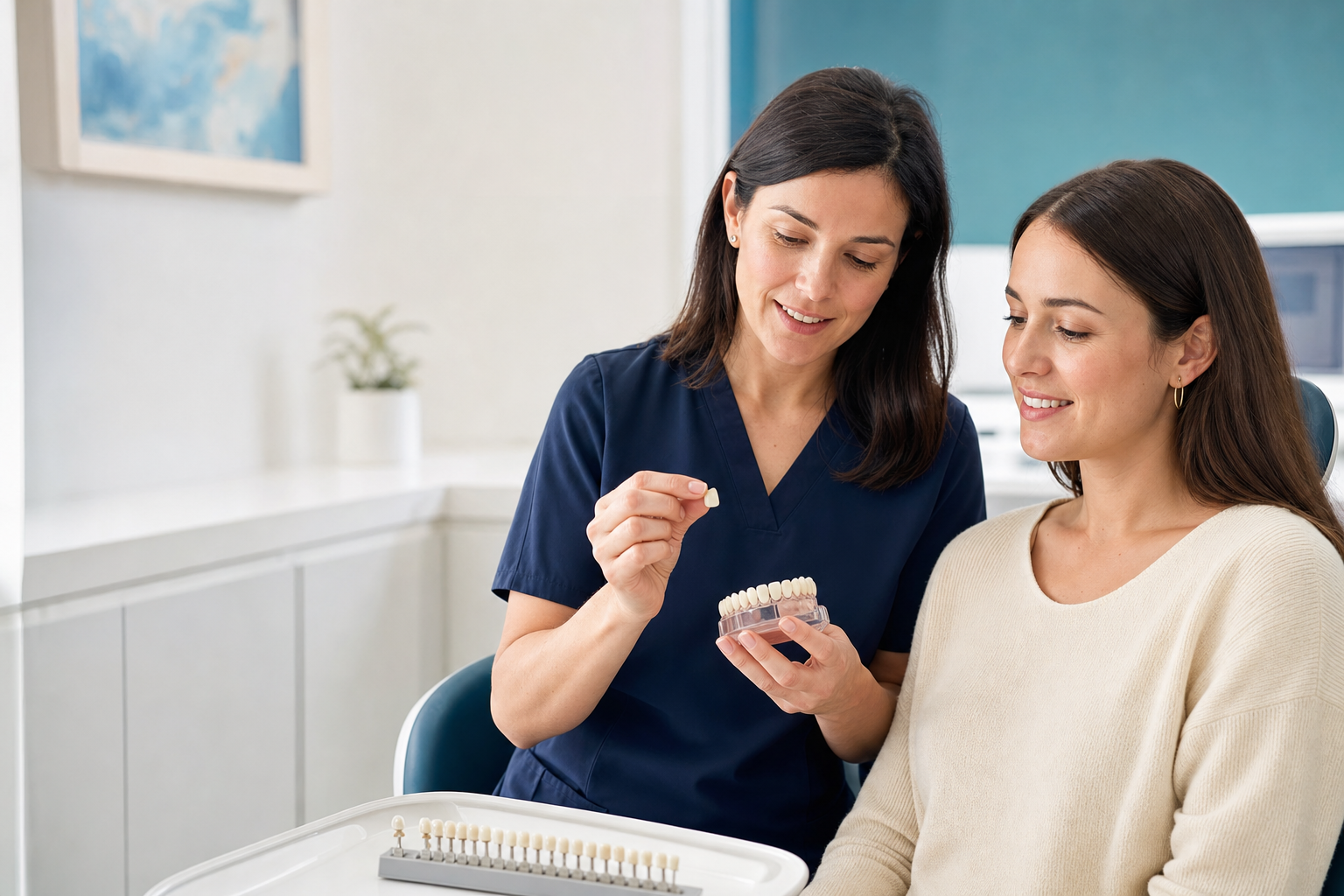
Patient safety: “Porcelain veneer” is a broad description. Ask which ceramic is proposed, why each tooth needs treatment and how much natural enamel will remain.
What are porcelain veneers?
Porcelain veneers are thin custom ceramic restorations bonded mainly to the front surfaces of teeth. They can modify colour, shape, length, symmetry and small spaces. The term may include feldspathic porcelain, leucite-reinforced glass ceramic and lithium disilicate. These materials differ in manufacture, strength, translucency and surface treatment.
Veneer or crown?
A veneer is a partial-coverage restoration. A crown wraps around most of the tooth and normally requires more reduction. Crowns can be appropriate for heavily damaged teeth but should not be relabelled as veneers in a marketing package. Patients should receive a tooth-by-tooth diagram showing the intended restoration.
Who may be suitable?
Veneers may be considered when an adult has stable oral health and a specific aesthetic or structural concern that cannot be met more conservatively. Examples include intrinsic discoloration, malformed teeth, localised spacing, selected worn edges or failed restorations. Suitability depends on enamel, existing fillings, pulp health, gum position, tooth alignment, available space and bite.
Who may need another plan first?
Untreated decay, gum disease and active erosion should be controlled. Orthodontics may be safer for pronounced crowding or protrusion. Severe grinding, an unstable bite or too little sound tooth structure can increase failure risk. Young teeth with large pulps require particular caution before irreversible preparation.
Conservative alternatives
- Whitening: changes natural tooth colour without covering it.
- Orthodontics: changes position and can create better restorative space.
- Composite bonding: can repair or reshape limited areas and is easier to repair.
- Enamel recontouring: can refine very small irregularities.
- Observation: is valid when the concern is cosmetic and the person does not accept irreversible treatment.
From consultation to final bonding
Diagnosis and design
The dentist examines teeth, gums and bite, and may take radiographs when clinically indicated. Photographs, scans and a diagnostic wax-up help communicate the proposed change. A mock-up can test length, speech and appearance.
Controlled preparation
Reduction should follow the planned final contour rather than a standard depth applied to every tooth. Depth-cutting guides can help preserve enamel. No-prep veneers are suitable only when added thickness will not create bulky or plaque-retentive contours.
Laboratory stage
A technician creates veneers from the prescribed ceramic using layering, pressing or milling. The prescription should include shade, translucency, texture and material details. Provisionals may be used to protect prepared teeth and evaluate form.
Try-in and bonding
Before irreversible cementation, fit, contacts, margins, colour and patient-approved appearance are checked. The internal ceramic surface and tooth are treated according to the material and adhesive system. Moisture control is critical.
How natural can veneers look?
Natural teeth vary in brightness, translucency, texture and symmetry. A believable result often uses restrained value, individual character and proportions that fit the face. Uniform opaque white blocks may photograph dramatically but can look artificial and may require greater masking. Expectations should be agreed under more than one lighting condition.
Risks and complications
Veneers can fracture, chip, debond, stain at margins or become mismatched as neighbouring teeth change. Teeth can become sensitive; decay or pulp complications can occur. Gum recession may expose a margin. Replacement can require further removal of tooth tissue. Some problems can be repaired, while others need a new veneer or a different restoration.
Longevity
A systematic review of 6,500 porcelain laminate veneers estimated 95.5% cumulative survival at ten years. A newer meta-analysis also reported high pooled long-term survival across common ceramic groups. These figures come from studied cases and do not guarantee a package result. Enamel bonding, preparation, occlusion, clinician and technician skill, habits and maintenance influence individual outcomes.
Aftercare
Use fluoride toothpaste twice daily and clean interdental areas. Veneer margins still meet natural tooth and remain susceptible to plaque-related disease. Avoid biting pens, ice or packaging. Attend recall visits based on caries, gum and mechanical risk. A night guard may be recommended for grinding.
Planning veneers abroad
Share recent records but expect an in-person diagnosis before final preparation. Build time into the itinerary for try-in, laboratory correction and recovery from sensitivity. Obtain the material, laboratory, shade, tooth numbers and warranty limitations in writing. Establish who will provide urgent and long-term care after returning home.
Frequently asked questions
Do veneers ruin teeth?
Properly indicated veneers can be conservative, but preparation and bonding are generally irreversible. Unnecessary or excessive reduction sacrifices healthy tissue and increases biological risk.
Do teeth need root canals first?
No. Root canal treatment is not a routine prerequisite for veneers and should have an independent clinical indication.
Can veneers close every gap?
No. Closing a large space only by widening teeth may create poor proportions or contours. Orthodontics or a combined plan may be more appropriate.
Sources and clinical review references
- Morimoto S, et al. Long-term survival and complications of porcelain laminate veneers. Clin Oral Investig. 2021.
- Klein P, et al. Ceramic laminate veneer survival by material. J Esthet Restor Dent. 2025.
- Alqutaibi AY, et al. Effect of bonding substrate on ceramic veneer outcomes. J Prosthet Dent. 2025.
Content status: editorial draft for review by a licensed dentist before publication. Last evidence check: 22 July 2026.