
Clinical review required: A night guard is an oral appliance, not a diagnosis. Fit, airway, teeth, joints and treatment objective require professional assessment and monitoring.
What is a night guard?
A night guard is a removable appliance worn over teeth during sleep. It is also called an occlusal splint, bite guard or stabilisation appliance, although designs differ. Its most defensible role is to separate and protect teeth and restorations from direct contact and distribute forces. It may help selected jaw-pain patients, but it does not reliably stop the nervous-system activity of sleep bruxism.
Why one may be recommended
Indications include active tooth wear, repeated chipping, vulnerable restorations, morning muscle symptoms or a conservative trial for some TMD diagnoses. Evidence of current risk should be documented. Historical wear that has been stable for years does not automatically require lifelong appliance use.
Hard stabilisation splints
A hard full-coverage acrylic or milled appliance fits all teeth in one arch and can be adjusted to stable contacts. It is durable, cleanable and reveals wear. Correct design avoids locking the jaw into a harmful position. Regular checks are needed because teeth, restorations and symptoms change.
Soft guards
Flexible thermoplastic guards may be comfortable and quick to provide, but they can wear, retain odour and sometimes increase chewing activity. Contacts are harder to adjust precisely. They may suit short-term sports-like protection or selected patients, but comfort alone does not establish therapeutic benefit.
Dual-laminate and hybrid materials
These combine a softer internal layer with a harder exterior. They can balance retention and durability but may delaminate or be difficult to adjust. Material choice depends on undercuts, restorations, allergy, clenching intensity and intended lifespan. No material is universally “best.”
Upper versus lower guard
Either arch can be used. Upper appliances often have good retention; lower designs may feel less visible and interfere less with the tongue in some patients. Missing teeth, gag reflex, periodontal support, restorations and jaw relationship influence selection. The opposing teeth must contact safely.
Full coverage versus partial coverage
Full coverage generally reduces unwanted tooth movement. Partial anterior or posterior devices can change eruption and bite if worn unsupervised, especially over long periods. Short-term diagnostic appliances have specific indications. Online partial guards should not be assumed safe for chronic use.
How a custom guard is made
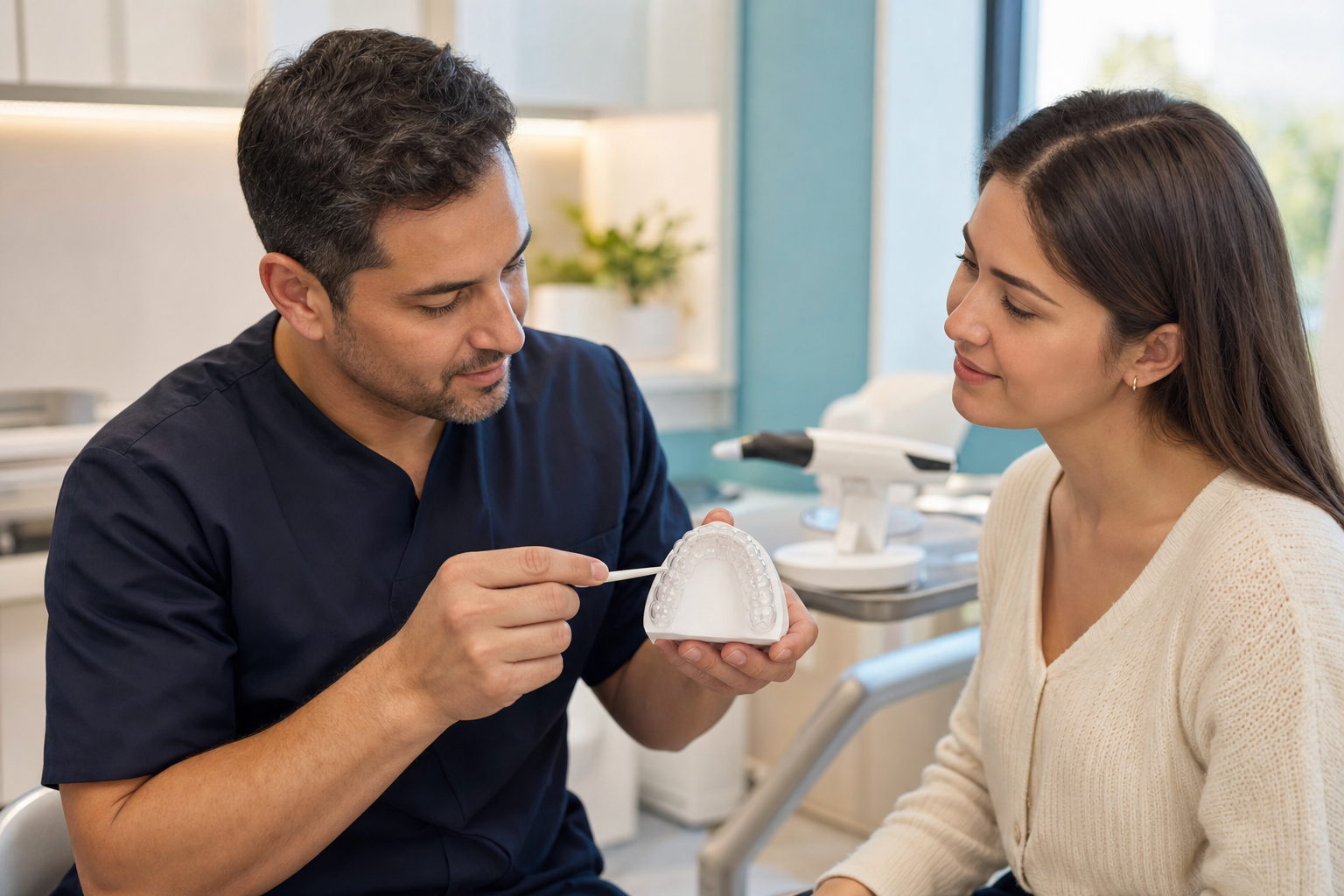
The clinician examines teeth, gums, muscles, joints and airway risk, then takes an impression or digital scan. A laboratory or chairside system fabricates the appliance. At delivery, borders, retention and contacts are adjusted, and insertion, removal and cleaning are demonstrated. Follow-up confirms comfort and bite stability.
Boil-and-bite and online guards
Over-the-counter guards are inexpensive but may be bulky, poorly retained or unevenly loaded. Online custom services improve fit but lack direct examination and adjustment. A loose appliance can be a choking risk; an uneven one can aggravate symptoms or move teeth. They are not appropriate substitutes where pain, mobility or complex restorations exist.
Does a guard treat bruxism?
A 2021 systematic review found insufficient evidence that splints outperform no treatment or other modalities for bruxism itself. They can still protect tooth structure. This distinction matters: marks on the appliance show it absorbed contact, not that sleep activity was cured. Management may also include sleep and behavioural assessment.
Does it treat TMD?
Splints have small beneficial or neutral average effects compared with other conservative TMD care. They may help muscle pain or restricted movement in selected patients. Exercise, education and manual therapy can perform similarly or better for some outcomes. A guard should be a monitored reversible trial, not proof the bite caused pain.
Airway and sleep apnoea
Snoring, witnessed pauses, gasping and daytime sleepiness require medical sleep assessment. A stabilisation guard is not a mandibular advancement device and does not treat obstructive sleep apnoea. Some designs may influence jaw or tongue position. The sleep physician and dentist should coordinate when both tooth protection and airway therapy are needed.
Fit and occlusal adjustment
A guard should seat fully without rocking, excessive pressure or sharp borders. Contacts are balanced according to design and reviewed after settling. A persistent new bite after removal, increased pain or inability to seat the appliance needs prompt adjustment. Patients should not grind the device at home.
Cleaning
Rinse after removal, brush gently with a separate soft brush and use products compatible with the material. Hot water can distort thermoplastic. Abrasive toothpaste scratches surfaces. Allow the guard and ventilated case to dry. Periodic professional cleaning and inspection remove calculus and detect cracks.
How long does it last?
Lifespan ranges from months to years depending on material, forces, care and dental changes. Deep grooves, perforation, cracks, looseness or persistent odour can require repair or replacement. A worn guard is clinical information but does not dictate extensive restorative treatment by itself.
Possible side effects
- Temporary salivation, dryness, speech or sleep disturbance.
- Pressure, gum irritation or gagging.
- Increased muscle or joint symptoms.
- Tooth movement or bite change, especially with partial coverage.
- Decay or gingival inflammation with poor hygiene.
- Fracture, swallowing or choking risk if damaged.
- Delayed diagnosis of sleep apnoea or dental disease.
Night guards with crowns and implants
A guard can protect ceramic and implant restorations but must fit their contours and allow hygiene. Implants lack periodontal ligament and do not absorb force like teeth. The appliance is adjusted after new restorations, and screws or components are monitored. A guard cannot compensate for a poorly designed or loose prosthesis.
Night guards with braces or aligners
Tooth movement makes a conventional rigid guard quickly obsolete. Orthodontist-designed alternatives may be needed. Clear aligners offer some separation but are not automatically bruxism appliances and can wear. Retainers and guards have different objectives; combining them requires professional design.
Children and teenagers
Growing jaws and erupting teeth demand caution. Many children grind transiently without damage. Airway symptoms, pain or severe wear need assessment. An appliance can interfere with eruption or become ill-fitting, so it requires frequent monitoring and should never be an unsupervised long-term purchase.
When not to wear it
Stop and seek advice if the appliance causes progressive pain, swelling, ulceration, marked bite change, breathing difficulty or cannot be retained safely. Do not wear a contaminated, fractured or poorly fitting device. Acute dental infection and mobile teeth require treatment rather than concealment under a guard.
Taking records and monitoring fit
A baseline scan or impression records current tooth position and wear. At reviews, the clinician checks whether the guard seats completely and whether any teeth have moved or restorations changed. A guard fabricated before a crown, filling, implant or orthodontic movement may no longer fit. Forcing it can damage the restoration or move teeth.
Night guard materials and allergy
Common materials include heat-cured or milled PMMA, printed resins, thermoplastics and laminates. Residual monomer, cleaning products or soft liners can cause irritation in susceptible people. A burning mouth, swelling or rash needs evaluation. Manufacturers’ instructions define cleaning and temperature limits. “BPA-free” marketing does not replace full material documentation.
CAD/CAM and printed guards
Digital scanning and milling can produce accurate, reproducible appliances, while three-dimensional printing allows efficient manufacture. Accuracy still depends on scan quality, design, post-curing and clinical adjustment. A digitally made guard is not automatically better than a well-processed conventional one. The clinic should retain the design file when future replacement is anticipated, while recognising teeth may change.
Saliva, dry mouth and decay
An appliance changes salivary flow and can trap plaque or acidic residue against teeth. Brush and clean interdentally before insertion and avoid sugary drinks while wearing it. Dry-mouth patients may need fluoride and medical review. New decay, white spots or gum bleeding indicates that hygiene, fit and wearing pattern need reassessment.
Travel and storage
Use a ventilated rigid case, keep the appliance away from heat and pets and carry it in hand luggage. Do not wrap it in tissue, where it is easily discarded. If it is lost, do not wear an old partial guard without checking fit. A backup digital file can speed remanufacture but does not eliminate the need to reassess current teeth.
Guard wear does not equal disease severity
Deep marks can reflect material softness, contact concentration and length of use as well as force. A pristine hard splint does not prove absence of bruxism, and a perforated soft guard does not quantify sleep episodes. Clinical decisions combine wear progression, symptoms, fractures and sleep information.
Replacing versus repairing
Small rough areas may be polished or repaired if material and thickness permit. Cracks, poor retention, significant perforation or bite change usually favour replacement. Repeated rapid failure prompts review of design, material, occlusion and diagnosis. Simply making the same guard thicker may increase bulk without solving concentrated loading.
Speech and adaptation
Most night guards are worn during sleep, but some people need a brief acclimatisation period before bedtime. Reading aloud can help with a new appliance used during waking hours. Persistent gagging or sleep disruption deserves redesign rather than forced endurance. Benefit should outweigh the burden of wear.
Morning bite changes
A brief sense that contacts feel different can occur after removing an appliance, but it should resolve quickly. Persistent open bite, inability to bring teeth together or progressive tooth movement requires stopping wear and prompt review. Partial coverage, tight fit and unmonitored long-term use increase concern. The clinician should compare current contacts with baseline records rather than simply grinding natural teeth to fit the appliance-induced position.
What to bring to reviews
Bring the guard, its case and notes about symptoms, wear schedule and any nights it was removed. Report new crowns, fillings, extractions or orthodontic work. The clinician inspects wear facets, retention, hygiene, borders and contacts. A review without the appliance cannot confirm whether it remains safe or repairable.
Treatment abroad
A guard usually needs adjustment after delivery, making remote manufacture or short travel packages less convenient. Obtain the diagnosis, design, material and digital scan. Ensure local follow-up for pressure spots and bite changes. Avoid appliances used to justify immediate permanent bite reconstruction.
Questions to ask
- What is the appliance intended to protect or improve?
- Why this material and arch?
- Is it full coverage?
- Have sleep-apnoea risks been screened?
- When will contacts be reviewed?
- What symptoms mean I should stop?
- How should it be cleaned?
- How will tooth wear or pain be monitored?
Frequently asked questions
Will a night guard stop grinding?
Not reliably. It mainly separates and protects teeth.
Can it change my bite?
Yes, particularly if partial, poorly fitting or unmonitored.
Can I buy one online?
Possible, but absence of examination and adjustment increases risk where pain, airway concerns or complex dentistry exist.
Should it be worn forever?
Duration depends on active risk and benefit and should be reviewed rather than assumed.
Sources and clinical review references
- Occlusal splints in bruxism treatment.
- Different occlusal splints for sleep bruxism.
- Occlusal splint therapy for TMD: umbrella review.
- Wear behaviour of occlusal splint materials.
Editorial review note: Evidence reviewed 22 July 2026. Named clinician review is required before indexation.