
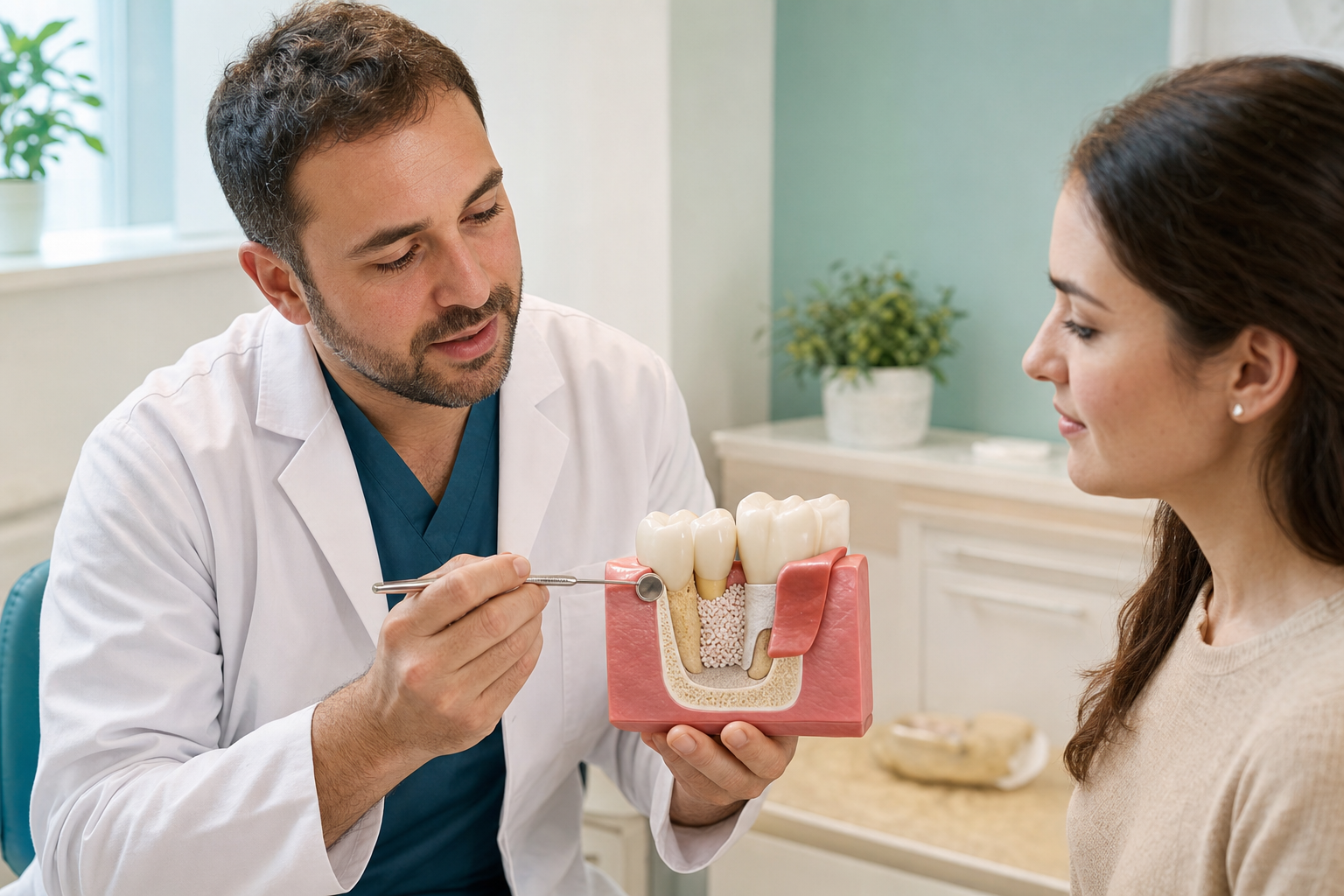
Clinical review required: Gum surgery includes distinct access, resective, regenerative and plastic procedures. Suitability requires controlled inflammation and site-specific planning.
What is gum surgery?
Gum surgery is an informal umbrella term for periodontal operations involving gingiva, roots and supporting bone. It may provide access to persistent periodontal pockets, reshape tissue and bone, regenerate selected defects, cover exposed roots, increase tissue thickness or expose tooth structure for restoration. These procedures have different aims and should not be sold as one standard package.
Why surgery may be recommended
Non-surgical instrumentation is first-line for periodontitis. Surgery is considered when deep bleeding pockets, inaccessible calculus, vertical bone defects, furcations, recession or restorative problems remain after risk control and reassessment. The objective must be stated: access, pocket reduction, regeneration, root coverage or crown lengthening. Surgery without a defined endpoint adds harm without benefit.
Preparation before surgery
Plaque control and smoking status strongly affect healing. Active deposits are removed and response is charted. Medical history, diabetes, bleeding risk and medications are reviewed. Radiographs or CBCT are selected according to anatomy. The surgeon discusses tooth prognosis, expected recession, alternatives and a contingency if the defect differs from imaging.
Access flap surgery
A flap is gently raised to expose roots and bone, allowing direct removal of deposits and diseased tissue. It is repositioned and sutured, often with minimal reshaping. Access can improve treatment of deep or complex sites but does not itself regenerate lost attachment. Healing may produce recession and sensitivity.
Resective periodontal surgery
Resective surgery changes gum and sometimes bone architecture to reduce pocket depth and create a contour that can be cleaned. It can be effective around non-contained defects or furcations but may lengthen visible teeth and affect aesthetics. A meta-analysis found greater short-term pocket reduction than access surgery, with no clear difference at longer follow-up.
Regenerative periodontal surgery
Regeneration aims to form new cementum, periodontal ligament and bone in selected intrabony or furcation defects. Guided tissue regeneration membranes, bone grafts, enamel matrix derivative and combinations may be used. Deep narrow contained defects respond more predictably than broad horizontal loss. Long-term systematic review evidence supports benefit from baseline but does not prove one universal material hierarchy.
Gingival grafts and root coverage
Connective-tissue grafts, free gingival grafts, coronally advanced flaps and substitutes can cover selected recessions or increase tissue thickness. Complete coverage is less predictable when attachment between teeth is lost. Donor tissue from the palate adds discomfort and bleeding risk. The procedure should address sensitivity, aesthetics or maintainability, not an arbitrary tissue measurement.
Crown lengthening
Crown lengthening removes or repositions gum and sometimes bone to expose sound tooth for restoration or change a gummy contour. Biological width and future crown margins guide the amount. Removing too much support can worsen prognosis or aesthetics. Restorative and periodontal plans must be coordinated before surgery.
Frenectomy and other soft-tissue procedures
A frenectomy alters a restrictive frenum when it contributes to tension, hygiene difficulty, orthodontic stability or function. Gingivectomy removes selected excess tissue without raising a full flap. Biopsy may be required for unusual enlargement. Laser, scalpel and electrosurgery are tools; diagnosis and wound design determine the result.
Local anaesthesia and sedation
Local anaesthesia is standard. Sedation may be considered for anxiety or extensive procedures after medical assessment, but it does not replace local pain control. Patients may feel pressure or vibration. Postoperative pain varies with flap extent, bone work and donor sites.
What happens during surgery?
After anaesthesia, incisions preserve or reposition papillae according to the goal. The flap is raised, roots are cleaned and the defect assessed. Bone may be reshaped or regenerative materials placed. The tissue is closed with sutures and sometimes a dressing. Operative records should identify sites, technique, materials, donor area and complications.
Microsurgical and minimally invasive techniques
Magnification, fine instruments and papilla-preservation flaps can reduce tissue trauma and improve wound stability in selected regenerative cases. “Minimally invasive” does not mean risk-free or incision-free. Restricted access can be unsuitable for broad defects. Operator training and defect selection matter more than the label.
Grafts, membranes and biologics
Autograft, donor-derived, animal-derived and synthetic materials have different remodelling and ethical considerations. Resorbable or non-resorbable membranes guide cell repopulation. Enamel matrix derivative is supported for selected intrabony defects; adding graft does not always produce a meaningful extra benefit. Exact products and origins belong in consent.
Early healing
The first weeks require stable clot and wound closure. Swelling and bruising peak early, while deeper maturation continues for months. Membrane exposure and flap opening can reduce regenerative outcomes. A systematic review found heterogeneous early-wound data and could not confirm a clear healing superiority for enamel matrix derivative over guided tissue regeneration.
Possible complications
- Pain, swelling, bruising and bleeding.
- Recession, sensitivity and longer-looking teeth.
- Flap opening, membrane exposure or graft loss.
- Infection, abscess or delayed healing.
- Donor-site bleeding, pain or numbness.
- Incomplete pocket reduction or root coverage.
- Tooth mobility, aesthetic change or need for extraction.
Smoking, diabetes and medicines
Smoking impairs blood supply and regenerative response. Poorly controlled diabetes increases infection and healing risk. Anticoagulants, immune-modifying, antiresorptive and antiangiogenic medicines require coordinated assessment; patients must not stop them independently. A complete medication list is essential.
Aftercare
Use prescribed medicines, rinses and cold packs as directed. Do not brush or floss the surgical site until instructed; clean the remainder of the mouth. Eat soft food, avoid smoking, alcohol and strenuous activity initially, and do not pull the lip to inspect the wound. Attend suture and healing reviews.
When to seek help
Contact the team for uncontrolled bleeding, rapidly increasing swelling, fever, pus, severe pain, wound opening, exposed membrane or graft, persistent numbness or a very mobile tooth. Breathing or swallowing difficulty requires emergency care. Do not self-start leftover antibiotics.
Reassessment and maintenance
Sutures are removed or reviewed according to material. Later probing is delayed until tissue can be assessed safely. The clinician compares pocket depth, bleeding, attachment, recession and patient comfort. Surgery does not replace supportive periodontal care. Cleanability and adherence govern long-term value.
Alternatives
Options include repeat site-specific instrumentation, local adjuncts, monitoring a stable non-bleeding site, extraction and replacement, or accepting recession rather than root coverage. Each has different biological, aesthetic and maintenance costs. No surgery is justified solely because a clinic owns a laser or biomaterial.
Evidence and expectations
Regenerative procedures can produce attachment gain and shallower pockets in selected intrabony defects, with benefits maintained under supportive care. Evidence certainty and defect variation prevent individual guarantees. Resective surgery may reduce pockets more initially but creates more recession. Outcomes should be expressed as ranges and trade-offs.
Flap design and papilla preservation
Incisions determine blood supply, visibility, closure and postoperative aesthetics. Papilla-preservation designs keep interdental tissue intact over a regenerative defect when anatomy allows. Releasing incisions can improve access but may scar or alter blood supply. The smallest flap is not always the safest; adequate visualisation and tension-free closure are essential. Surgical design should be adapted to defect and tissue rather than selected from a fixed branded protocol.
Sutures and periodontal dressings
Monofilament or braided sutures, resorbable or non-resorbable, are chosen for handling, plaque retention and planned review. They stabilise tissue but cannot compensate for a tensioned flap. Periodontal dressings may protect selected wounds but are not mandatory for all surgery. A loose dressing or suture should be reviewed rather than pulled by the patient.
Palatal donor-site care
Connective-tissue or free gingival graft harvesting leaves a palatal wound that can bleed and feel more uncomfortable than the recipient site. A stent, sutures or haemostatic material may protect it. Persistent bleeding requires pressure and prompt contact with the surgeon. Numbness, ulceration or severe pain should also be assessed. Donor thickness and greater palatine artery anatomy limit the harvest.
Root-coverage expectations
Coverage depends on recession type, interdental attachment, tooth position, root prominence, tissue thickness and flap tension. Complete coverage is more likely when interdental support is intact. Even successful early coverage can change over years. Outcomes should include sensitivity, tissue thickness and maintainability, not only a photograph taken soon after surgery.
What if regeneration fails?
Failure may present as wound opening, membrane exposure, infection, little attachment gain or progressive pocketing. Management ranges from antiseptic care to membrane or graft removal and debridement. After healing, options include maintenance, repeat surgery, resective treatment or extraction. Repeating the same procedure without addressing smoking, plaque, flap tension or defect anatomy is unlikely to improve predictability.
Periodontal surgery around implants
Peri-implant surgery is related but not identical to tooth surgery because implants lack periodontal ligament and have different surface geometry. Resective, regenerative and soft-tissue procedures may be used for peri-implantitis or mucosal deficiencies. Implant-surface decontamination remains challenging and evidence is variable. Patients should not assume a gum graft or laser will predictably reverse every peri-implant defect.
Returning to work and exercise
Desk work may be possible after a short recovery, while extensive bilateral surgery, palatal harvesting or bone work can require more time. Swelling often peaks after the first day. Strenuous exercise can provoke bleeding and should resume according to instructions. Plan important speaking, travel and social events with realistic allowance for sutures, swelling and temporary dietary limitations.
Nutrition during healing
Soft, nutrient-dense food and adequate hydration support recovery. Chew away from the site and avoid sharp, very hot or seedy foods that can disturb a flap. A restrictive liquid diet is rarely necessary unless instructed. Patients with diabetes need a plan that preserves regular nutrition and medication safety. Supplements do not replace protein, calories and prescribed wound care, and high-dose products can interact with medicines.
Cosmetic expectations
Periodontal surgery can improve contour, yet early photographs are affected by swelling and tissue maturation continues for months. Crown margins, tooth position, papilla support and lip line influence the visible result. Root coverage, crown lengthening and pocket surgery may have competing aesthetic goals. The clinician should explain which changes are intended, which are unavoidable and when restorative work can safely begin.
Treatment abroad
Request baseline and post-initial-therapy charts, radiographs, site diagnosis, surgical goal, graft and membrane details and donor-site plan. Remain for early wound and suture care. Obtain operative records and product traceability. Ensure a periodontist at home can manage exposure, infection and long-term maintenance.
Questions to ask
- What exact problem requires surgery?
- Is the goal access, resection, regeneration or root coverage?
- What happened after non-surgical treatment?
- What recession or aesthetic change is expected?
- Which graft, membrane or biologic is proposed?
- What happens if the wound opens?
- Is there a donor site?
- How will success be measured?
Frequently asked questions
Does gum surgery regrow all lost bone?
No. Regeneration is defect-specific and usually partial.
Will it make teeth look longer?
Access and resective surgery can increase recession; the expected change should be discussed beforehand.
Is laser gum surgery always better?
No. The surgical objective and evidence matter more than the cutting tool.
Can surgery cure periodontitis permanently?
No. It can control selected residual sites, but maintenance and home care remain lifelong.
Sources and clinical review references
- Pocket-reduction versus access-flap surgery.
- Long-term outcomes of regeneration for intrabony defects.
- Early wound healing after periodontal regenerative surgery.
- Medium- and long-term regenerative/reconstructive outcomes.
Editorial review note: Evidence reviewed 22 July 2026. Named clinician review is required before indexation.