
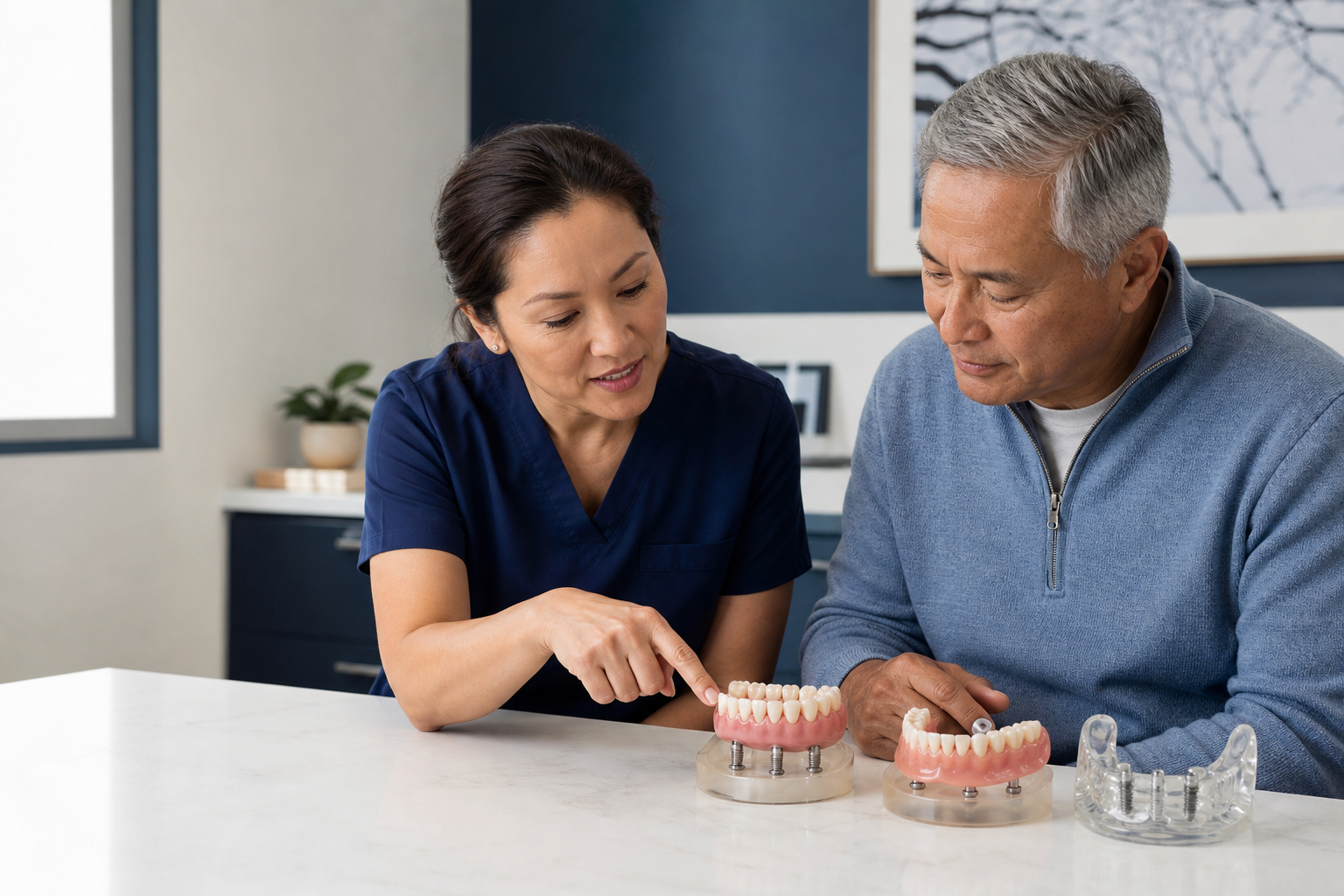
Scope: Full mouth dental implants can mean fixed or removable rehabilitation of one or both toothless arches. It does not mean one implant for every missing tooth, and extraction of restorable teeth requires independent justification.
What are full mouth dental implants?
Full mouth implant treatment replaces a complete upper arch, lower arch or both using implants that support a fixed bridge or removable overdenture. The implants are surgical foundations; the visible teeth and gum replacement form the prosthesis. The number of fixtures, their distribution and the prosthetic design are planned together.
Who may need complete-arch rehabilitation?
Candidates may already be edentulous or have teeth with a collectively poor prognosis from advanced periodontal disease, extensive decay, fractures or repeated prosthetic failure. A mouth containing some compromised teeth is not automatically terminal. Each tooth's prognosis, strategic value and treatment burden should be compared with staged preservation and removable options.
Fixed bridge or overdenture?
Fixed complete prosthesis
A fixed bridge is secured to implants and normally removed only by a clinician. It can feel stable and reduce palatal coverage, but requires sufficient restorative space and meticulous cleaning underneath.
Implant overdenture
An overdenture clips onto implants or a bar and is removed by the patient for cleaning. It may replace lost tissue and lip support more easily and can be simpler to maintain. Attachments wear and need replacement.
“Fixed” is not automatically better. Facial support, dexterity, speech, hygiene access, anatomy, cost and repair strategy determine the appropriate design.
How many implants are required?
Common fixed concepts use four, six or more implants per arch; overdentures may use fewer depending on jaw and design. Implant count alone is an incomplete quality measure. Distribution, anterior-posterior spread, bone, implant dimensions, cantilever, opposing bite and framework matter. A 2024 meta-analysis found no significant survival or complication difference between four- and six-implant maxillary fixed complete prostheses in included studies, but individual anatomy still decides.
Why the upper and lower jaws differ
The maxilla often has softer bone, sinus limitations and greater aesthetic/lip-support demands. The mandible may offer dense anterior bone but contains the inferior alveolar nerve and can have severe posterior resorption. A protocol appropriate for one arch should not be copied automatically to the other.
Comprehensive assessment
Records include medical and medication history, smoking, periodontal diagnosis, remaining-tooth prognosis, jaw relationships, smile and lip support, speech, dexterity and expectations. CBCT evaluates bone and anatomy when justified. Intraoral scans or impressions record prosthetic space. Existing dentures can provide valuable information about tooth position and facial support.
Prosthetically driven planning
The future tooth and gum positions are designed before implants. The plan determines where screw channels should emerge and whether the bridge can be cleaned. A surgical guide can transfer placement, but guide fit, bone change after extraction and surgical judgement remain critical. Implants placed wherever bone is easiest may produce a bulky, uncleanable bridge.
Keeping or extracting remaining teeth
Extraction is irreversible. Teeth with treatable disease may support a staged plan, removable prosthesis or transitional bridge. Conversely, retaining hopeless teeth can prolong infection and complicate implant positioning. A tooth-by-tooth chart should document periodontal support, restorability, endodontic status and strategic value.
Bone reduction and alveoloplasty
Some fixed designs require controlled bone reshaping to create prosthetic space, a level platform or a hidden transition between prosthetic and natural gum. Bone removal is permanent and can make future alternatives harder. Ask how much bone will be removed and whether the same objective can be achieved with a different prosthesis.
Bone grafting and sinus augmentation
Grafting may rebuild deficient ridges or sinuses. Tilted or short implants and alternative prostheses can sometimes reduce grafting. Each approach trades anatomy, surgical risk and prosthetic limitations. The material, staging, donor site and effect on treatment time should be documented.
Immediate loading and “teeth in a day”
Selected patients receive a fixed provisional bridge on the day of surgery or soon after. This requires adequate primary stability and a rigidly connected prosthesis. The provisional is not usually the final bridge; it is designed for healing and controlled load. If stability is inadequate, a removable temporary or delayed loading may be safer.
The surgical appointment
Teeth may be extracted, bone reshaped, implants placed and grafts added under local anaesthesia with or without sedation. Multiunit abutments can correct prosthetic access and create a common restorative platform. Surgery length and recovery depend on arch count and additional procedures. Sedation does not eliminate postoperative swelling or biological healing time.
The provisional bridge
A provisional bridge restores appearance and limited function while tissue heals. It must fit passively and allow hygiene. A soft or modified diet reduces overload. Fracture, looseness or bite change requires prompt assessment because movement can compromise components or implants.
From provisional to definitive
After integration and tissue maturation, records are made for the definitive prosthesis. Try-ins verify jaw relation, midline, tooth display, phonetics, lip support and hygiene space. Framework fit is checked before final torque. A rushed same-day final restoration removes opportunities to adapt to tissue remodelling and validate design.
Materials
Options include acrylic or composite teeth on a metal framework, monolithic zirconia, layered zirconia and hybrid designs. Acrylic can be repairable and lighter but wears and fractures; zirconia can offer strength and polish but is heavier, may be difficult to repair and needs adequate design. Material choice is secondary to fit, space and cleanability.
FP1, FP2 and FP3 concepts
An FP1 prosthesis mainly replaces tooth crowns; FP2 replaces crowns plus some root form; FP3 replaces teeth and lost gum volume. Severe resorption often needs an FP3 design with pink material. Hiding the junction under the lip and preserving cleansability are central. Patients should see how much artificial gum will be present.
Speech and lip support
Changing tooth position, palatal contour and vertical dimension can affect “s,” “f” and “v” sounds. Removing a denture flange can reduce lip support; a fixed bridge may need prosthetic gum volume to restore it. Provisional testing and wax try-ins are more reliable than selecting teeth from a photograph.
Biological risks
Implants can fail to integrate or develop peri-implant mucositis and peri-implantitis. Bleeding, suppuration and bone loss are not normal ageing. Smoking, history of periodontitis, diabetes control, plaque and inaccessible contours affect risk. Full-arch stability can mask a failing individual implant until professional examination.
Mechanical and prosthetic risks
Screws, abutments, teeth, veneering and frameworks can loosen, wear or fracture. Cantilever length and grinding influence load. A prosthesis may survive while requiring repairs. The team should explain whether one damaged tooth can be replaced or the entire bridge must be remade.
Cleaning beneath a fixed arch
Daily cleaning uses appropriately sized interdental brushes, threaders, superfloss or water irrigation as an adjunct. The bridge should have surfaces the patient can reach. Professional maintenance may include removing the prosthesis when indicated, but routine removal schedules vary and repeated screw cycles also require control.
Recovery and warning signs
Swelling, bruising and soreness are expected early. Follow medication, rinsing, diet and cleaning instructions. Uncontrolled bleeding, fever, increasing swelling, persistent numbness, pus, a mobile implant or loose provisional bridge requires urgent review. Long-distance travel should not begin before early stability is checked.
Medical risk and sedation
Long surgery and multiple extraction sites make medical assessment important. Diabetes control, cardiovascular disease, immune conditions, bleeding risk, radiotherapy and antiresorptive medication may alter timing or suitability. Sedation can improve tolerance but adds fasting, escort and monitoring requirements. It does not convert a high-risk surgical plan into a low-risk one.
Bruxism and opposing dentition
Clenching or grinding can increase provisional fracture, screw loosening and material wear. The opposing arch may be natural teeth, a denture or another implant bridge, each creating different load. Cantilevers and crown height amplify forces. Bite design, material, implant distribution and a protective appliance are considered together.
Verification of passive fit
A full-arch framework should seat without being forced. Clinicians may use verification jigs, radiographs, digital scans or photogrammetry. The bridge is checked before final screw torque. Digital manufacture can improve reproducibility but does not prove fit; inaccurate scan bodies, mobile tissue or a mis-seated component can still introduce error.
What if one implant fails?
The plan depends on implant location, remaining support and timing. Options include removing and replacing the implant, redesigning the provisional, extending healing or changing to a removable prosthesis. A full-arch bridge can remain apparently stable while one implant loses integration, which is why individual clinical and radiographic checks matter.
Hygiene design before surgery
Patients should see a cross-sectional preview of the bridge-to-gum space and demonstrate dexterity with cleaning tools. A convex, polished surface can reduce stagnation, while deep concavities trap plaque. Excessively tight tissue contact may look seamless in photographs but become painful or impossible to clean after swelling resolves.
Repair and replacement economics
Ask the expected service intervals for provisional teeth, attachment inserts, acrylic, ceramic and screws. A chipped tooth may be repaired; a fractured monolithic framework can require complete replacement. Laboratory access, archived digital files and compatible components affect cost. The initial fee should not be treated as lifetime cost.
Independent second opinion
Before clearing an entire arch, obtain a second opinion when several teeth could be restorable, large bone reduction is proposed or the treatment is based only on remote images. Provide full radiographs and periodontal charting. The reviewer should explain prognosis and staged alternatives, not merely offer a competing package.
Success and survival
Systematic reviews report high implant and prosthesis survival for fixed complete mandibular rehabilitation over ten years in selected cohorts. Survival does not mean absence of repairs, tissue inflammation or replacement. Outcomes vary by jaw, design, follow-up and patient selection, so headline percentages are not a personal guarantee.
Full mouth implants in Turkey
Request a written arch-by-arch diagnosis, extraction rationale, implant map, graft plan, provisional specification and definitive material. Confirm which items are temporary. Obtain implant passports, abutment and screw references, torque records, scans, radiographs and laboratory details.
Questions to ask
- Which teeth are hopeless, and which could be retained?
- Why is fixed treatment preferable to an overdenture for me?
- Why are this implant number and distribution selected?
- Is bone being removed or grafted?
- What happens if immediate loading criteria are not met?
- How is the bridge cleaned, removed and repaired?
- Who provides maintenance after I return home?
Frequently asked questions
Are full mouth implants one implant per tooth?
No. A complete bridge is supported by a strategically distributed number of implants.
Are the same-day teeth permanent?
Usually they are a provisional bridge. The definitive prosthesis is commonly made after healing and verification.
Can I eat normally immediately?
A modified soft diet is often required during early healing. Follow the surgeon's load instructions.
Sources and clinical review references
- Sharaf MA, et al. Four versus six implants for a maxillary fixed complete prosthesis. Heliyon. 2024.
- Papaspyridakos P, et al. Long-term survival of mandibular implant fixed complete prostheses. Clin Implant Dent Relat Res. 2014.
- Wang HL, et al. AO/AAP consensus on peri-implant disease prevention and management. J Periodontol. 2025.
Content status: editorial draft for review by a licensed dentist before publication. Last evidence check: 22 July 2026.