Clinical scope: E-Max is a widely used brand family associated with lithium disilicate glass ceramic. This guide focuses on a tooth-supported E-Max crown for restoring a damaged tooth, not veneers, implant fixtures or a multi-crown cosmetic package.
What is an E-Max crown?
An E-Max crown is an all-ceramic complete-coverage restoration commonly made from lithium disilicate. The material contains a glassy matrix with reinforcing crystals, allowing translucency, strength and adhesive bonding. It can be pressed from ingots or milled with CAD/CAM. The trade name does not guarantee that every crown follows the same design, thickness or laboratory protocol.
When may it be used?
Lithium disilicate crowns can restore compromised anterior teeth and selected premolars or molars when sufficient thickness and bonding or retention are available. They may mask moderate discolouration, rebuild wear or cover a large restoration. Heavy parafunction, very limited space or a severely dark substrate may favour another material or design.
Does the tooth need a full crown?
A crown removes tooth structure around the entire tooth. An onlay, overlay, veneer or direct composite may be more conservative when sound axial enamel remains. The diagnosis considers cracks, cusp thickness, existing filling, decay and bite. Choosing E-Max for aesthetics does not make full coverage biologically necessary.
Lithium disilicate material
Lithium disilicate is an etchable glass ceramic. Hydrofluoric-acid conditioning under controlled instructions creates a micromechanical surface, and silane supports resin bonding. This differs from zirconia, which uses other surface treatments and primers. Material-specific steps matter; using a generic “ceramic cement” protocol can weaken retention.
Pressed E-Max
In the heat-press technique, a wax pattern is invested and ceramic ingot pressed into the mould. The restoration can be stained, cut back and layered. Pressed fabrication has established use and can reproduce detailed margins when the impression and laboratory process are accurate. Technician skill and firing cycles influence fit and appearance.
CAD/CAM E-Max
A partially crystallised block is milled, tried or adjusted as appropriate, then crystallised and characterised. Digital scanning can streamline records, but moisture, margin capture and software design still matter. Milling bur size limits internal geometry. Same-day manufacture is possible in some clinics but should not omit tissue control, shade evaluation or post-crystallisation fit checks.
Monolithic and layered designs
A monolithic crown uses the lithium disilicate body through most of its form with stains or glaze. Cut-back and layered designs add veneering ceramic for nuanced aesthetics but introduce another chipping interface. Anterior characterisation may justify layering, while monolithic occlusal surfaces can simplify mechanics. Adequate support is essential in either design.
E-Max versus zirconia
Lithium disilicate is generally more translucent and readily bonded after etching; zirconia offers higher strength and better masking in many formulations. Modern translucent zirconias narrow the aesthetic gap but may trade strength. Site, substrate colour, thickness, preparation retention and load determine the choice. There is no universal material winner.
E-Max versus porcelain-fused-to-metal
E-Max contains no metal coping and can provide natural light transmission without an opaque metal layer. Metal-ceramic crowns have extensive evidence and can mask dark cores effectively but may show metal if tissue recedes. Both can chip or lose retention. The comparison should include preparation, margin position and laboratory design rather than aesthetics alone.
Anterior indications
In incisors and canines, lithium disilicate can reproduce translucency and colour gradients. The prepared-tooth shade and cement influence the result. Thin tissue, neighbouring restorations and smile line are recorded. A crown may be excessive for a healthy discoloured tooth; bleaching, bonding or a veneer can preserve more enamel.
Posterior indications
Lithium disilicate can be used for selected posterior crowns when material thickness and occlusion are controlled. Molar load, limited clearance and bruxism increase fracture concern. Adhesive onlays may preserve more structure while protecting cusps. The manufacturer’s indication and clinical evidence for the exact design should be followed.
Substrate colour
Because glass ceramic transmits light, dark dentine, metal posts and discoloured cores can affect final value. Different opacity ingots or blocks and resin cement shades help manage this, but heavy masking can reduce vitality. The laboratory needs a stump-shade photograph. A zirconia-based option may be more predictable for severely dark substrates.
Preparation design
The preparation provides rounded internal angles, continuous margin, sufficient ceramic thickness and a path of insertion. Sharp corners and thin edges concentrate stress. Overpreparation risks the pulp and reduces enamel available for bonding. Underpreparation can create an overcontoured crown or thin ceramic. Reduction guides from a diagnostic wax-up help calibrate removal.
Margin placement
Margins are ideally accessible for scanning, bonding and cleaning. Subgingival placement may be required for decay, previous restorations or aesthetics, but deeper is not automatically better. Bleeding and moisture compromise adhesive procedures. Equigingival or supragingival margins preserve tissue when the clinical situation allows.
Ferrule and structural support
Heavily damaged teeth need sound circumferential structure above the margin. A core replaces missing volume but does not correct a short or fractured root. Crown lengthening or orthodontic extrusion may create ferrule. When adequate support cannot be achieved, extraction and replacement may be more predictable than bonding an aesthetic crown to a weak foundation.
Root canal treated teeth
Lithium disilicate can restore root-treated teeth if remaining structure and ferrule are adequate. A post is used only when needed to retain the core. It does not reinforce the root. The endodontic result and symptoms are checked first. In some molars, an endocrown or adhesive overlay may be considered instead of conventional full coverage.
Digital scan and impression
Intraoral scanners can capture a clean visible margin and support CAD/CAM. Deep or bleeding margins remain difficult. Conventional impressions also require displacement and dryness. The record includes opposing teeth and bite. An accurate scan of an unstable gingiva or unclear preparation still produces an inaccurate crown.
Temporary crown
A provisional protects the tooth and tests contour, contact and bite. It should maintain tissue health and not contaminate the preparation before bonding. Eugenol-containing temporary materials may interfere with some resin systems. A loose temporary should be recemented because movement, sensitivity and tooth migration can compromise final seating.
Try-in pastes and shade
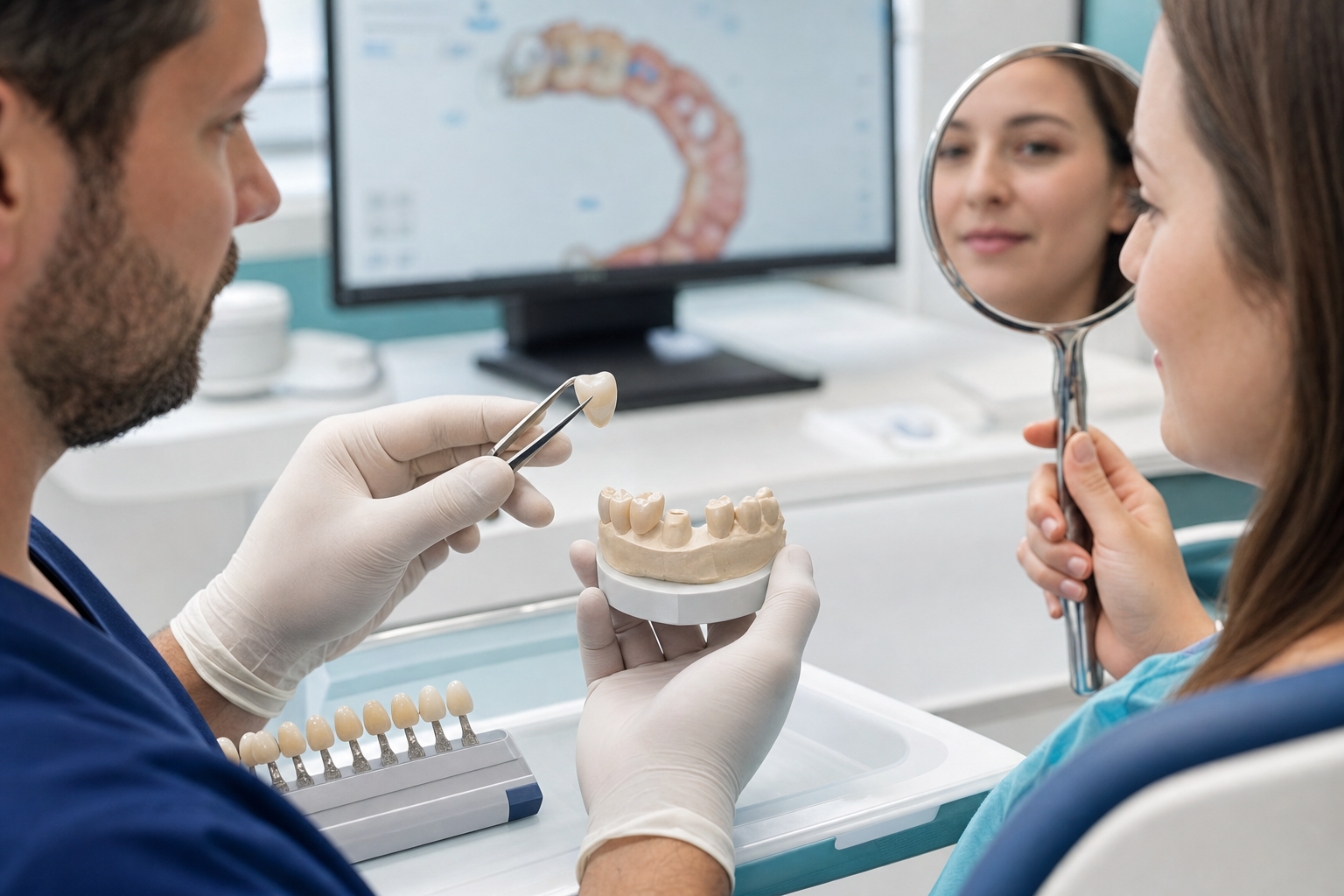
Try-in paste can preview the influence of resin cement shade, particularly in translucent restorations. The crown is evaluated hydrated and under different light. Neighbouring teeth can dehydrate and appear whiter during long appointments, so final judgement is delayed if necessary. The patient approves visible appearance before bonding.
Isolation
Adhesive cementation requires control of saliva, blood and crevicular fluid. Rubber dam, retraction and suction may be used according to margin location. If reliable isolation is impossible, preparation and cement strategy may need reconsideration. Strong material cannot compensate for a contaminated bond at delivery.
Etching and silanisation
The internal ceramic is etched for the manufacturer-specified time, thoroughly rinsed and treated with silane or a compatible ceramic primer. Overetching, incorrect acid or contamination can impair the surface. The tooth is conditioned according to enamel, dentine and resin protocol. These steps are timed and protected from saliva.
Resin cement
Light-cure, dual-cure or other resin cements may be selected based on ceramic thickness and opacity. The cement affects colour and cleanup. Excess is removed without opening margins, and curing reaches all surfaces as the material permits. A systematic review found comparable broad survival patterns across cement approaches but limited-quality evidence, reinforcing case-specific selection.
Occlusal adjustment and polish
Contacts are adjusted with suitable instruments and the ceramic is repolished. Rough glass ceramic can wear the opposing tooth and initiate surface flaws. Glaze alone may be lost during adjustment. The final surface should be smooth, and bite checked in closure and excursions. A high crown can cause pain or fracture risk.
Postoperative sensitivity
Short-term sensitivity can occur in vital teeth after preparation and bonding. Persistent spontaneous or biting pain needs assessment for occlusal trauma, pulpal inflammation, crack or cement issues. Root canal treatment may become necessary even after careful preparation. Patients should receive a contact route rather than assume all pain is normal adaptation.
Fracture and chipping
Lithium disilicate can fracture from inadequate thickness, sharp preparation, impact, poor support or heavy load. Layering ceramic can chip separately. Minor roughness may be polished or repaired; a structural crack usually requires replacement. The cause is analysed so the same design is not repeated. Bruxism may favour another material or protective strategy.
Loss of retention
Debonding can result from contamination, incorrect surface treatment, limited preparation or overload. Crown and tooth are inspected for fracture and decay. Rebonding requires cleaning and reconditioning the ceramic without damaging it. Repeated loss suggests that simply using a stronger cement is insufficient.
Secondary caries
The ceramic does not decay, but tooth margins do. Diet, plaque, dry mouth and margin integrity influence risk. Fluoride toothpaste and interdental cleaning remain necessary. A hidden recurrent lesion can progress beneath an intact crown. Regular clinical and radiographic review is based on individual risk.
Gum health
Healthy tissue depends on margin, contour and plaque control, not the absence of metal. Overbulked cervical ceramic and residual cement cause inflammation. Bleeding should be investigated. Recession can expose a margin and change appearance. Tissue stability is improved by conservative, cleansable placement and periodontal control before impressions.
Longevity and evidence
Systematic reviews support lithium disilicate as a viable single-crown material, with performance influenced by site, design and study follow-up. Survival is not the same as never needing intervention. Chipping, debonding, pulp problems and caries occur. Long-term success depends on the tooth foundation and maintenance as much as ceramic brand.
Aftercare
Brush the margin twice daily with fluoride toothpaste and clean interdentally. Avoid hard-object habits and report movement, persistent pain, roughness or food trapping. A night guard may be recommended for grinding. Reviews assess tissue, margin, contacts and occlusion and compare radiographs when clinically indicated.
Patients should not use abrasive polishing products in an attempt to brighten the ceramic. Surface stain is managed professionally, while the underlying shade cannot be bleached. Changes in neighbouring natural teeth may eventually create a colour mismatch even when the E-Max crown itself remains intact and functional.
Treatment abroad
Ask whether the restoration is authentic lithium disilicate, pressed or milled, monolithic or layered, and obtain shade, block or ingot, cement and laboratory details. Allow time for try-in and adjustment. If a crown fractures after travel, records help a local clinician choose repair or replacement and match adjacent work.
Questions to ask
- Would an onlay or veneer preserve more enamel?
- Why lithium disilicate instead of zirconia?
- How will the dark substrate be managed?
- Can the field be isolated for bonding?
- What thickness and bite risks apply?
- Is the crown pressed, milled, monolithic or layered?
Frequently asked questions
Is E-Max stronger than zirconia?
Generally no; zirconia has higher strength, while lithium disilicate often offers adhesive and optical advantages.
Can E-Max be whitened?
No. Complete bleaching before final shade selection if whitening is planned.
Can it be used on a molar?
Yes in selected cases with adequate thickness and controlled load, but material choice is patient-specific.
Sources and clinical review references
- Lithium disilicate and zirconia CAD/CAM crown performance.
- Cement type and lithium disilicate crown outcomes.
- CAD/CAM all-ceramic tooth-supported restorations.
- Long-term zirconia and lithium disilicate outcomes.
Editorial review note: Evidence reviewed 22 July 2026. Named clinician review is required before indexation.