
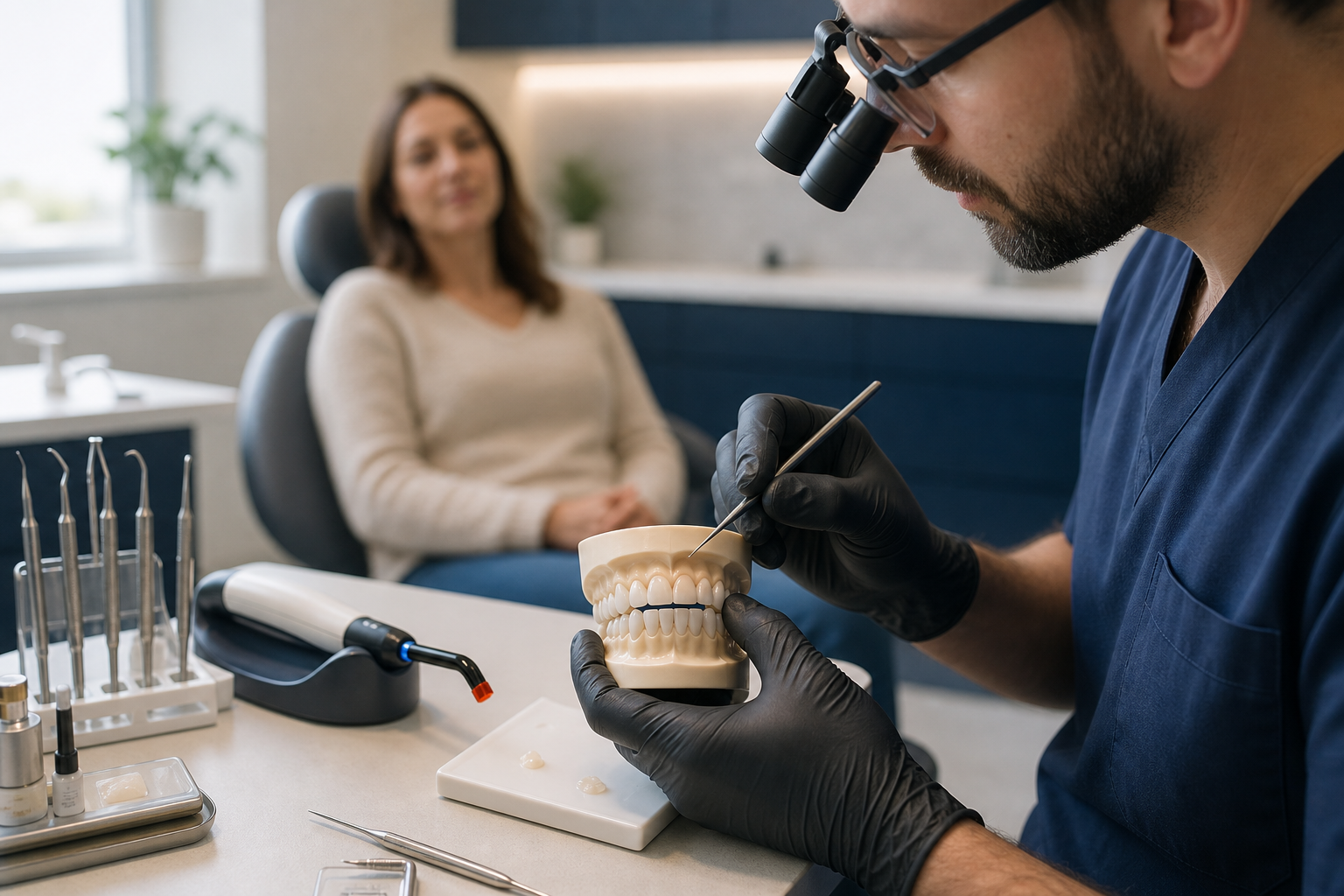
Scope: Composite bonding is an additive restorative technique, not a single standard package. The number of teeth and amount of preparation should follow a diagnosis.
What is composite bonding?
Composite bonding uses tooth-coloured resin applied directly to enamel or dentin, shaped by the dentist and hardened with a curing light. It may repair a chip, rebuild a worn edge, close a small space, improve symmetry or mask a localised defect. “Edge bonding” usually means adding material mainly to the incisal edge; “composite veneer” covers more of the facial surface.
When is it useful?
Bonding is often considered for limited changes where substantial healthy tooth structure remains. It can be valuable after orthodontics, for small developmental shape differences, local fractures or conservative trial changes. It is not a treatment for active decay, uncontrolled gum disease or the cause of severe tooth wear.
What should be diagnosed first?
The clinician should examine cracks, decay, erosion, bite contacts, grinding, tooth position, enamel quantity and gum health. Repeated edge chipping may be a symptom of an unfavourable contact or parafunction rather than simply weak material. Treating only the visible defect can lead to repeated failure.
Bonding compared with porcelain veneers
Direct composite is usually completed in one clinical stage and can often be repaired or modified. It may require little or no preparation and costs less initially. Ceramic generally provides better long-term gloss and colour stability and may offer more controlled laboratory aesthetics. Composite is more prone to staining, roughness and marginal wear, but repairability can make it a sensible conservative choice.
The procedure
Planning
Photographs, shade selection and a wax-up or mock-up may be used for multiple teeth. Whitening should normally precede shade matching because composite does not bleach predictably later.
Isolation and surface treatment
The tooth is cleaned and isolated. Enamel is conditioned, adhesive is applied and composite is built in controlled layers. Rubber dam isolation may improve moisture control where feasible.
Shaping, curing and polishing
Each layer is light-cured. The dentist recreates line angles, contact points and surface texture, then checks the bite in several movements. Finishing and polishing reduce roughness and help plaque control, although composite surface quality changes with use.
Does bonding require drilling?
Many additive cases need no drilling or only minor enamel roughening. Existing decay, a failed filling or a protruding contour may require removal. “No drilling” should be confirmed tooth by tooth; it should not be assumed from a treatment label.
Benefits
- Often highly conservative and sometimes additive.
- Usually completed without a laboratory stage.
- Can be repaired, polished or modified.
- Useful as an interim or definitive option in selected cases.
- Lower initial cost than laboratory ceramics in many settings.
Limitations and risks
Composite can chip, wear, stain, lose gloss and develop marginal discoloration. A thick or over-contoured restoration may trap plaque or alter speech. Sensitivity, recurrent decay and gum irritation are possible. Colour matching a single front tooth is technically demanding. Repairs add interfaces that also require monitoring.
How long does composite bonding last?
There is no single expiration date. Location, size, remaining enamel, bite, diet, smoking, grinding, operator technique and maintenance all matter. Evidence on resin-composite laminate veneers suggests moderately high survival but more frequent surface roughness, colour mismatch and marginal discoloration than patients may expect. Maintenance and occasional repair are part of the treatment model.
Aftercare
Brush with fluoride toothpaste, clean between teeth and attend reviews. Tea, coffee, tobacco and strongly coloured foods may stain composite over time. Avoid using bonded edges to bite very hard objects. Do not use abrasive whitening products in an attempt to change the restoration colour. Professional repolishing may refresh the surface when appropriate.
Composite bonding in Turkey
Ask whether the quoted treatment is edge bonding, spot repair or full facial composite veneers. Review unfiltered close-up photographs, not only distant social-media images. Confirm the composite system, isolation method, polishing appointment, repair policy and time allowed for bite adjustment. Low-cost treatment across many healthy teeth may create a maintenance burden that is not evident in the package price.
Frequently asked questions
Is bonding reversible?
Additive bonding may be more reversible than ceramic treatment, but removal without touching enamel cannot always be guaranteed. Any prior preparation makes the change less reversible.
Can bonding be whitened?
No predictable bleaching occurs in composite. Whitening natural teeth first allows a new composite shade to be matched.
Can a dentist repair a chip?
Often yes, depending on the cause, remaining material and bite. The reason for chipping should be assessed before simply adding resin.
Sources and clinical review references
- Lim TW, et al. Survival and complication rates of resin composite laminate veneers. J Evid Based Dent Pract. 2023.
- Demarco FF, et al. Anterior composite restorations: systematic review of longevity. Dent Mater. 2017.
- Hickel R, et al. FDI criteria for evaluating direct and indirect dental restorations. Clin Oral Investig. 2023.
Content status: editorial draft for review by a licensed dentist before publication. Last evidence check: 22 July 2026.