
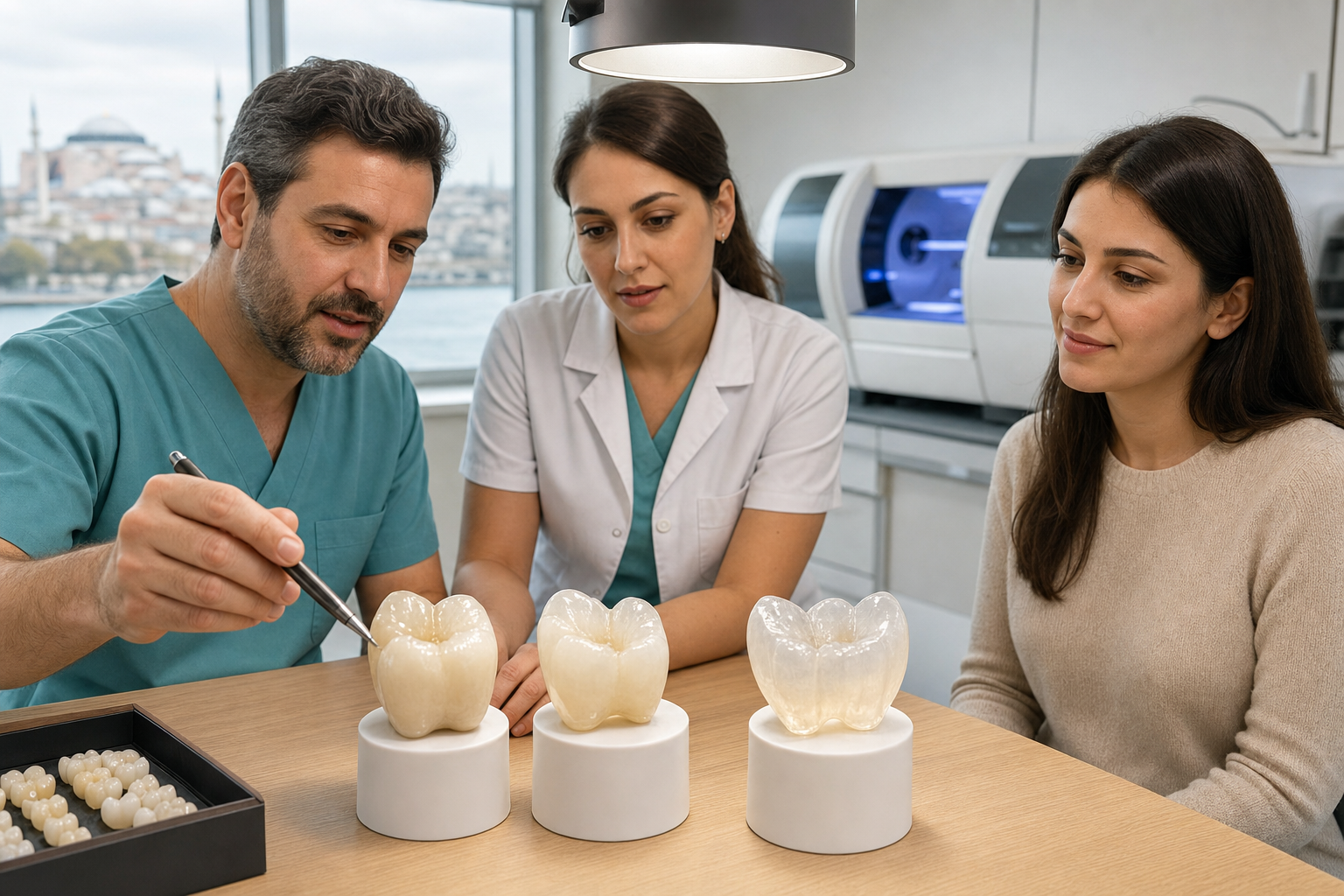
Clinical review required: Zirconia is a family of dental ceramics with different strength, translucency and clinical indications. “Zirconia” alone does not identify grade, design, processing, connector size, surface treatment or whether a restoration is monolithic or layered.
What is dental zirconia?
Dental zirconia is a polycrystalline ceramic based on zirconium dioxide stabilised with oxides such as yttria. It contains no glass phase like lithium-disilicate ceramics. Zirconia’s crystal structure provides high strength and fracture resistance, while newer compositions trade some strength for increased translucency. Selection should match restoration type, thickness, colour and load.
Not all zirconia is the same
Common labels such as 3Y, 4Y and 5Y broadly refer to yttria content and crystal-phase balance. Traditional 3Y-TZP is generally stronger and less translucent; higher-yttria materials can look more translucent but usually have lower transformation toughening and strength. Marketing names may obscure composition, so the laboratory and clinician should document the actual material.
Monolithic versus layered zirconia
A monolithic restoration is milled mainly from one zirconia body and stained or glazed. A layered restoration uses a zirconia framework covered with veneering ceramic for characterisation. Layering can improve optical control but introduces a veneering layer that may chip. Monolithic design reduces that interface but is not immune to fracture, wear or aesthetic limitations.
Common uses
Zirconia is used for tooth-supported crowns and bridges, implant crowns and bridges, abutments, full-arch frameworks and selected removable-prosthesis components. The same formulation and design are not suitable for every use. Long-span prostheses require adequate connector dimensions, passive fit, screw access and support.
Strength and fracture resistance
Zirconia’s high flexural strength makes it useful where space and load are challenging. Clinical survival also depends on preparation, thickness, connector design, milling damage, sintering, occlusion and support. A strong material cannot compensate for a non-restorable tooth, insufficient clearance or an inaccurate framework.
Translucency and aesthetics
More translucent zirconia can suit anterior teeth, but opacity may be useful for masking dark substrates or metal components. Final appearance depends on material thickness, shade, surface texture, stump colour, cement and lighting. A sample tab cannot fully predict a finished restoration, especially across multiple units.
Preparation requirements
Preparation should provide smooth, rounded geometry, sufficient reduction for the selected zirconia and a readable finish line while preserving tooth structure. Very thin claims are material- and design-specific. Under-reduction can create bulky contours or weak veneering space; over-reduction increases pulpal and structural risk.
Retention and bonding
Some zirconia crowns can be conventionally cemented when preparation geometry provides retention. Adhesive bonding may be chosen for short preparations, partial restorations or other indications. Zirconia does not respond to hydrofluoric-acid etching like glass ceramic; air abrasion and phosphate-monomer primers or resin cements may be used according to validated protocols.
Contamination and surface treatment
Saliva and try-in contamination can reduce bonding if not cleaned appropriately. Surface treatment must be controlled because excessive abrasion can damage the restoration. Laboratory sandblasting, chairside cleaning, primer and cement steps should form one compatible protocol rather than a mix of unrelated products.
Wear of opposing teeth
Well-polished zirconia can be kind to opposing enamel, while roughened, adjusted or poorly finished surfaces may increase wear. After occlusal adjustment, polishing with a zirconia-specific sequence is important; glaze alone can wear away. Patients with bruxism need design, contact and maintenance planning rather than material selection alone.
Chipping and fracture
Layered zirconia may chip in the veneering ceramic. Monolithic zirconia can fracture when too thin, poorly supported, damaged or overloaded, although framework fracture is less common. Small chips may be polished or repaired; structural fracture usually requires replacement and investigation of fit, design and bite.
Ageing and low-temperature degradation
Some zirconia can undergo surface phase transformation in moist, low-temperature environments over time. Modern materials and processing aim to control this, but composition and manufacturing matter. Laboratory ageing studies do not translate directly into an individual clinical lifespan; they help compare mechanisms rather than guarantee years of service.
Zirconia crowns on teeth
Monolithic zirconia crowns show favourable short- to medium-term clinical performance when properly indicated. Biological complications such as decay, pulp disease and periodontal inflammation remain possible because they relate to the tooth and margin, not just the ceramic. Maintenance and cleansable contours are essential.
Zirconia implant restorations
Zirconia can be used above titanium implants as crowns, bridges, abutments or frameworks. Screw loosening, component fracture, chipping and hygiene access depend on the whole implant–prosthesis system. “Metal-free crown” does not necessarily mean there is no titanium implant or screw beneath it.
Full-arch zirconia
Full-arch zirconia prostheses can provide strength and stable surface finish but are rigid and relatively heavy. Passive framework fit, adequate restorative space, cleansable tissue contours and repair planning matter. If a large monolithic prosthesis fractures or chips, repair can be complex. Opposing dentition and parafunction must be evaluated.
Zirconia versus metal ceramic
Zirconia avoids a metal framework and may improve colour at thin tissues, while metal-ceramic restorations have long clinical history and predictable masking. Complication patterns differ. The better option depends on span, space, aesthetics, laboratory expertise, repairability and patient factors rather than a universal hierarchy.
Zirconia versus lithium disilicate
Lithium disilicate offers glass-ceramic optics and predictable etching/bonding, often making it attractive for veneers and partial restorations. Zirconia usually offers greater strength and masking. Modern translucent variants blur the boundary, but indication, thickness and bonding substrate remain decisive.
Shade matching and try-in
The team should record photographs, shade tabs, stump shade and material selection. Try-in assesses fit, contacts, bite and appearance before final cementation when feasible. Thick opaque zirconia cannot be transformed into high translucency by cement shade alone, and excessive external stain can look artificial or wear.
Cleaning and maintenance
Brush and clean between units or beneath implant prostheses using tools that reach the contours. Professional maintenance checks margins, screws, contact wear, chipping and gum health. Abrasive polishing or unapproved scaling instruments can roughen surfaces; clinicians should use material-compatible protocols.
Treatment abroad and material records
Request manufacturer, product, yttria category or composition, batch, monolithic or layered design, CAD file, milling centre, sintering schedule, cement and surface-treatment protocol. For implants, obtain framework and screw details. “Premium zirconia” without traceable documentation is not a technical specification.
Questions to ask
- Which zirconia composition and product will be used?
- Why is it suitable for this tooth or span?
- Is the restoration monolithic or layered?
- What thickness and connector dimensions are planned?
- How will adjustment be polished?
- How can the restoration be repaired or replaced?
Frequently asked questions
Is zirconia unbreakable?
No. It is strong but can chip or fracture when design, support, processing or load is unfavourable.
Is all zirconia white and opaque?
No. Compositions and colouring systems provide different translucency and shade ranges.
Can zirconia be bonded?
Yes, with material-specific surface cleaning, treatment and compatible resin chemistry when indicated.
Is zirconia completely metal-free?
The ceramic itself contains no metal framework, but implant components beneath it may be titanium.
Sources and clinical review references
- Monolithic tooth-supported zirconia restorations: systematic review.
- Zirconia fixed prosthesis survival and complications.
- Tooth- and implant-supported zirconia prostheses.
- All-ceramic and metal-ceramic single crowns.
Editorial review note: Evidence reviewed 22 July 2026. Named clinician review is required before indexation.