
Urgent clinical review required: A dental abscess can spread beyond the tooth. Breathing or swallowing difficulty, floor-of-mouth or neck swelling, eye involvement, high fever, confusion or rapid progression requires emergency medical assessment.
What is a tooth abscess?
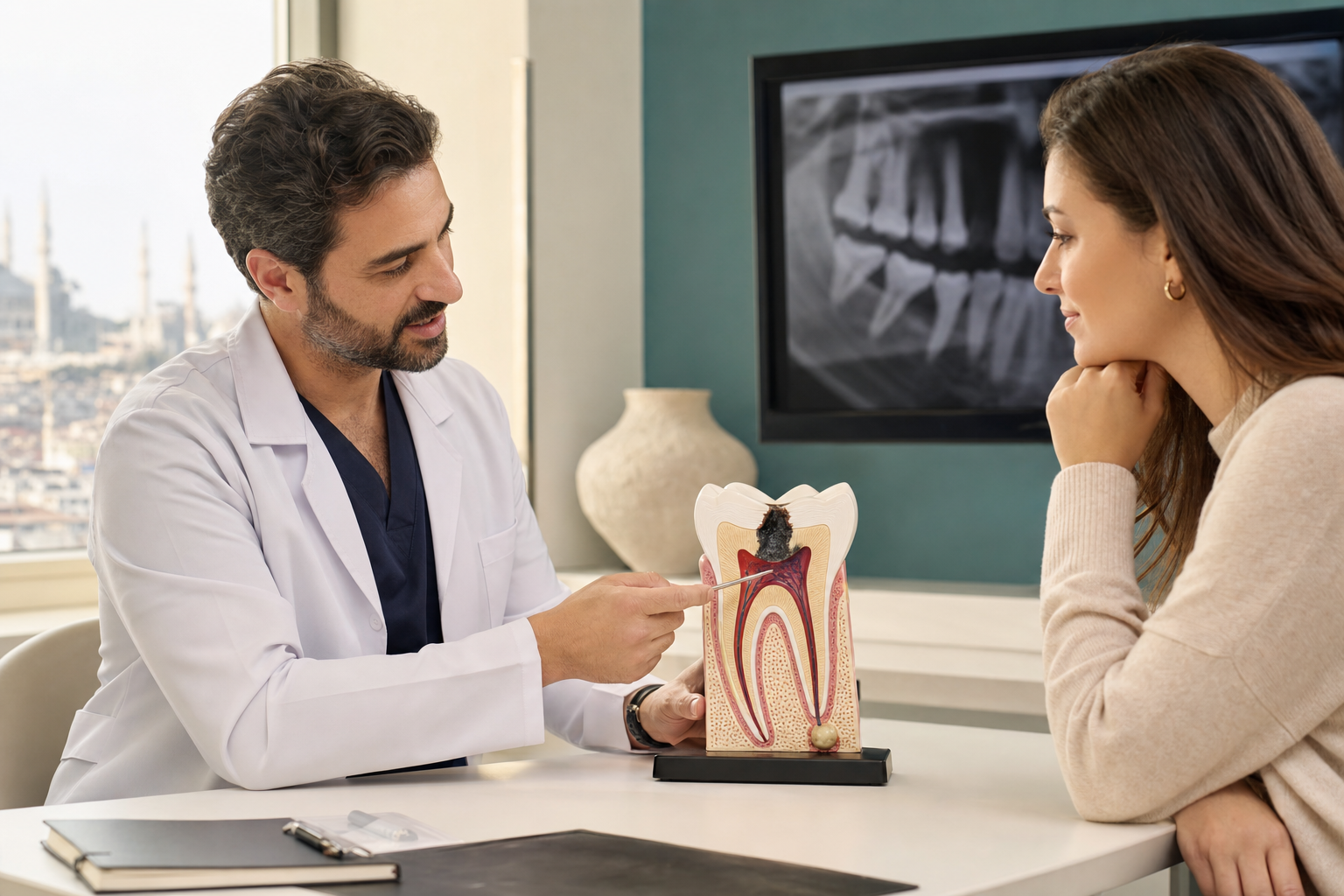
A tooth abscess is a local collection of pus associated with bacterial infection. A periapical abscess begins from an infected or necrotic pulp near the root tip. A periodontal abscess forms within the gum and supporting tissues. The word describes a clinical state, not the treatment; the source must be identified.
Common symptoms
Severe throbbing pain, tenderness to biting, gum or facial swelling, bad taste, pus, fever and swollen lymph nodes can occur. The tooth may feel raised or mobile. A gum pimple can drain intermittently and reduce pain. Some abscesses cause limited discomfort until pressure builds or infection spreads.
Why an abscess forms
Deep decay, a crack, traumatic pulp death, failed root-canal treatment or a leaking restoration can infect the root-canal system. Periodontitis, food or foreign material in a deep pocket and incomplete drainage can produce periodontal abscesses. Wisdom-tooth infection and salivary or skin disease can mimic dental swelling.
Periapical versus periodontal abscess
A periapical abscess usually involves a non-vital or infected pulp and is treated through root-canal care or extraction. A periodontal abscess often has a deep pocket and may involve a vital tooth; drainage and periodontal treatment are central. Combined lesions exist, so pulp testing and probing are important before treatment.
Is every abscess visible?
No. Pus may collect near a root or drain through a small sinus tract with little facial swelling. Radiographs can show bone change but may appear normal early. Examination, symptoms and tests determine urgency. A radiographic dark area is not automatically an acute abscess.
What to do now
Arrange urgent dental assessment. Use pain relief only within medical safety limits, maintain hydration and choose soft food. Do not squeeze, pierce or heat the swelling. Do not place aspirin or chemicals against the gum and do not take another person's or leftover antibiotics.
Emergency red flags
- Difficulty breathing, swallowing or speaking normally
- Drooling or inability to handle saliva
- Swelling beneath the tongue, jaw or into the neck
- Eye swelling, vision change or severe one-sided headache
- Rapid progression, marked trismus or muffled voice
- High fever, confusion, faintness or severe dehydration
Why location matters
Infection follows pathways of least resistance into anatomical spaces. Lower molar infections can involve the floor of mouth and neck; upper teeth can affect the cheek or sinus, and some pathways approach the orbit. Size visible on the skin does not reliably measure internal risk.
Diagnosis
The clinician assesses airway and systemic condition first, then examines swelling, mouth opening, tooth vitality, biting tenderness, periodontal pockets and drainage. Dental radiographs identify likely sources. CT or hospital imaging may be needed for deep-space spread, airway risk or uncertain anatomy.
Drainage
Drainage reduces pressure and bacterial load. It may be achieved through root-canal access, incision, extraction or periodontal instrumentation depending on the source. A drain may be placed for larger collections. Temporary relief after spontaneous drainage does not remove the source.
Root-canal treatment
If the tooth is restorable, root-canal treatment can disinfect and seal the canal source. Acute drainage may be followed by completion after symptoms stabilise. The tooth needs a durable final restoration. Leaving an access cavity open to the mouth for prolonged periods encourages reinfection.
Extraction
Extraction provides source control when the tooth is unrestorable, fractured, severely unsupported or not suitable for endodontic treatment. Drainage and medical support may still be required for spreading infection. Replacement decisions should not delay emergency source control.
Antibiotics
Antibiotics are indicated when infection is spreading, systemic involvement is present or individual medical risk justifies them. A small localised abscess that can be drained may not benefit from routine antibiotics. Drug selection requires allergy and medical review; resistance and adverse effects make unsupervised use unsafe.
Why painkillers and antibiotics are not enough
Analgesics reduce symptoms but do not drain pus. Antibiotics may have limited penetration into an enclosed necrotic source and cannot restore the tooth. Delaying operative treatment can permit recurrence or spread even when pain temporarily improves.
Hospital treatment
Patients with airway threat, deep-neck or orbital spread, sepsis, dehydration, significant immune compromise or failure of outpatient care may require hospital admission. Treatment can include intravenous fluids and antibiotics, advanced imaging, airway management and surgical drainage by oral and maxillofacial or ENT teams.
Children
Facial swelling in a child can progress quickly and deserves urgent assessment. Treatment may involve pulp therapy or extraction according to the tooth and infection. Antibiotic doses are weight- and condition-specific. A child who is lethargic, dehydrated, struggling to swallow or rapidly swelling needs emergency medical care.
Pregnancy
Necessary dental drainage, imaging with appropriate precautions and suitable local anaesthesia should not be postponed solely because of pregnancy. Untreated infection can be more harmful than correctly selected care. Medicine choices should be coordinated with the dental and maternity team.
Diabetes and immune compromise
Poorly controlled diabetes, chemotherapy, immune-suppressing drugs and other conditions can increase severity or blunt typical signs. Tell the clinician about diagnoses and medicines. Lower thresholds for escalation, blood tests or hospital care may apply.
After drainage
Take medicines exactly as prescribed, maintain hydration and attend the planned definitive treatment. Swelling should stabilise and improve; worsening pain, fever, spread, breathing or swallowing difficulty requires immediate reassessment. Complete root-canal and final restoration appointments rather than treating drainage as the endpoint.
Can an abscess return?
Yes, if the canal source, deep periodontal pocket, fracture or defective restoration remains. Reinfection can also follow leakage or new disease. Long-term prevention includes caries control, periodontal maintenance, restoration review and timely management of cracks.
Treatment abroad and travel
Do not fly simply because antibiotics have been started if swelling is unstable or definitive source control is pending. Obtain the diagnosis, imaging, drainage details, medicines and emergency contacts. Confirm who will complete root-canal treatment or monitor healing after return.
Questions to ask
- Where is the source?
- Can it be drained today?
- Can the tooth be restored?
- Why are antibiotics indicated or not indicated?
- Which warning signs require hospital care?
- What definitive treatment remains?
Frequently asked questions
Can I pop a dental abscess?
No. Home puncture can spread infection and does not remove the tooth or periodontal source.
Will it go away after it drains?
Pain may decrease, but the source generally remains and recurrence is likely without treatment.
Can an abscess be dangerous?
Yes. Although most are treated before severe spread, airway obstruction, deep-neck infection, orbital complications and sepsis can occur.
Do I always need antibiotics?
No. Local drainage and source control are primary; antibiotics are added for spread, systemic involvement or specific risk.
Sources and clinical review references
- Systemic antibiotics for acute apical abscess.
- Antibiotic resistance in odontogenic infections.
- Complications of severe odontogenic infections.
- Systematic review of antibiotic use in odontogenic infections.
Editorial review note: Evidence reviewed 22 July 2026. Named clinician review is required before indexation.