
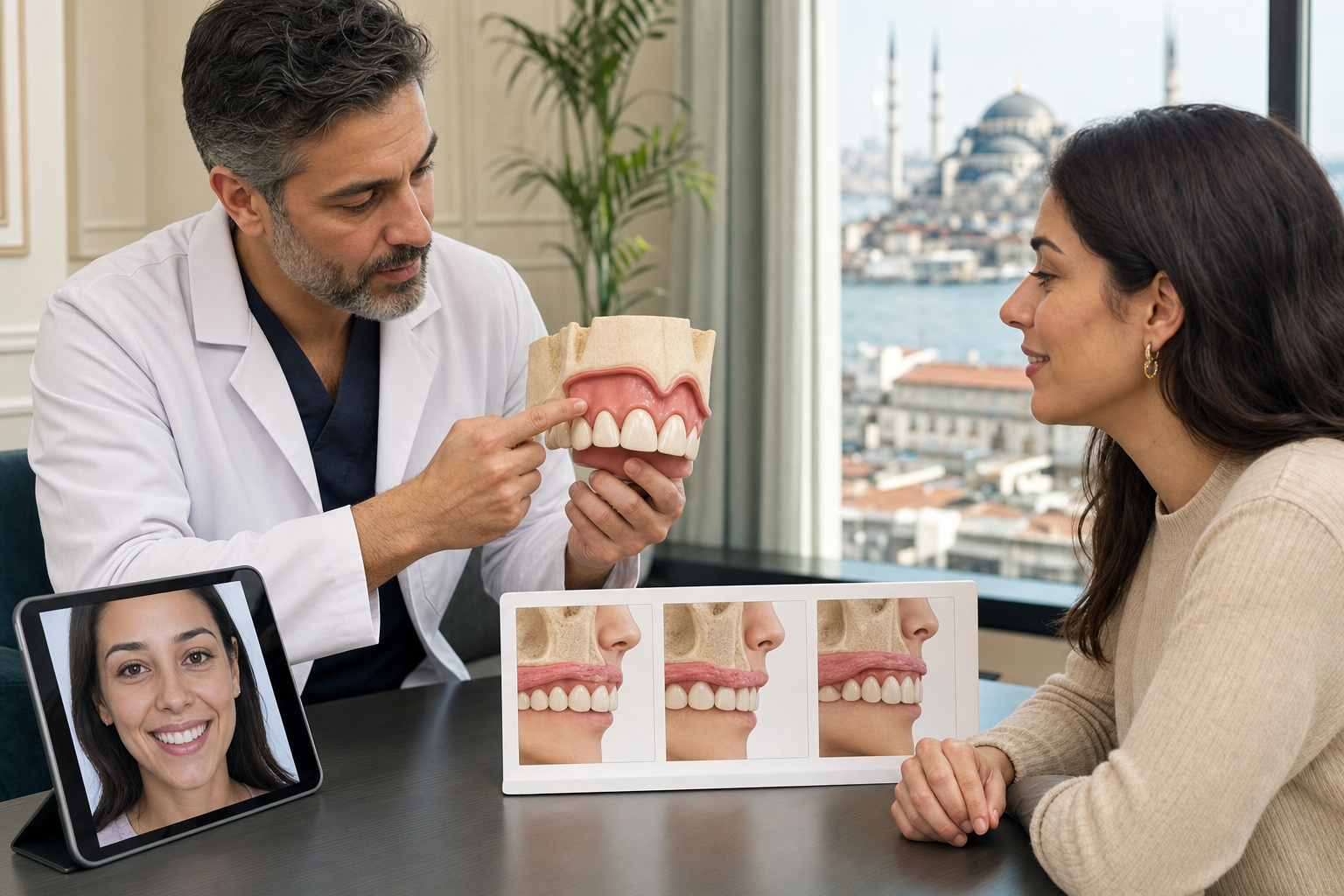
Clinical review required: Excessive gingival display can arise from short clinical crowns, altered eruption, upper-lip movement, vertical maxillary excess, tooth position or combinations. A cause-specific diagnosis is required before gum removal, injections, orthodontics or jaw surgery.
What is a gummy smile?
“Gummy smile” is a common term for showing more upper gum during smiling than a person prefers. Gingival display exists on a continuum and aesthetic perception varies with age, culture, lip form, tooth proportions and personal identity. It is usually not a disease, but gum inflammation or altered eruption may coexist.
Why gums show
Possible contributors include short or incompletely erupted-looking teeth, excess gum covering enamel, a hypermobile or short upper lip, vertical overgrowth of the upper jaw, extrusion of front teeth and dentoalveolar position. Several causes frequently overlap. The correct treatment for one mechanism can be ineffective or harmful for another.
Assessment
The clinician measures gum display at rest and full smile, lip length and movement, visible tooth dimensions, gum levels, bone relationship, bite and facial proportions. Photographs and video capture dynamic smiling more accurately than a posed still image alone. Periodontal probing and radiographs help locate the enamel and supporting bone.
Short-looking teeth
Teeth may look short because gum covers part of the enamel, because they are genuinely small, worn or positioned differently, or because the lip exposes more tissue. Removing gum without confirming tooth and bone anatomy can expose roots, violate biological tissue dimensions or create long uneven teeth.
Gum inflammation
Swollen, red or bleeding gums can increase visible tissue. Plaque control and periodontal treatment come before aesthetic surgery. Healthy tissue levels should be reassessed after inflammation resolves. Cosmetic contouring does not treat periodontitis or replace daily cleaning.
Gingivectomy and gum contouring
Soft-tissue reshaping removes excess gum when enough tissue can be safely removed without exposing bone or compromising stability. Laser, scalpel or electrosurgery are tools; diagnosis matters more than the device. Gingivectomy alone may relapse when underlying bone remains too close to the desired margin.
Aesthetic crown lengthening
Crown lengthening can reposition gum and, when necessary, supporting bone to expose anatomical tooth structure. It may improve proportions in altered passive eruption. Healing and tissue maturation take time before final veneers or crowns. Risks include sensitivity, root exposure, black triangles and asymmetry.
Orthodontic treatment
Orthodontic intrusion or repositioning can reduce gingival display when tooth and dentoalveolar position contributes. Temporary anchorage devices may assist selected movements. Root position, bone limits and smile arc must be controlled. Orthodontics is not a solution for every skeletal or lip-driven case.
Lip repositioning
Lip-repositioning surgery limits upward movement by removing and suturing a strip of inner lip tissue. It may suit selected mild-to-moderate soft-tissue cases. Relapse, tightness, asymmetry, scar sensation and altered smile are possible. It does not correct vertical maxillary excess at the skeletal level.
Botulinum toxin
Botulinum toxin can temporarily reduce elevator-muscle activity when a hypermobile upper lip is a major cause. Effect develops and fades over months, requiring repeat treatment. Dose and injection placement affect symmetry, speech and lip competence. It does not correct short teeth or jaw excess and must be delivered by a qualified clinician under local rules.
Orthognathic surgery
For significant vertical maxillary excess, jaw surgery may provide a structural correction that gum or lip procedures cannot. Treatment typically combines orthodontics and maxillary repositioning. It involves hospital care, recovery, nerve, bleeding, relapse and anaesthetic risks and is reserved for carefully selected patients.
Veneers and crowns
Restorations can change tooth shape and proportion but do not remove a skeletal or lip cause. If gum and tooth dimensions are planned together, veneers may refine final appearance after tissue stabilises. Lengthening teeth without controlling active display can create oversized or biologically invasive results.
Combined treatment
Mixed causes may require staged periodontal, orthodontic, restorative, injectable or surgical care. A reversible botulinum trial can sometimes help estimate the muscular component, but it does not simulate bone or gum surgery perfectly. Sequence is designed to preserve tissue and allow healing between stages.
Digital Smile Design
Photographs, video, scans and digital mock-ups can demonstrate proposed tooth and gum proportions. The preview is an communication tool, not a biological guarantee. It should incorporate full facial movement and periodontal measurements rather than cropping the mouth alone.
Healing and stability
Soft-tissue contour changes during healing. Crown-lengthening cases may need months before definitive restorative margins are selected. Botulinum effects are temporary, and lip repositioning can relapse. Orthodontic and surgical outcomes require retention and follow-up according to the procedure.
Risks of overtreatment
Excessive gum removal can expose roots, increase sensitivity and create long teeth or black triangles. Repeated injections can alter expression. Restorations may require unnecessary enamel removal. Treatment should start with the least invasive option that addresses the diagnosed cause and the patient's priorities.
Treatment abroad
Request full-smile video, periodontal probing, bone-level assessment and written aetiological diagnosis. Ask whether proposed laser contouring includes bone surgery and how long healing precedes veneers. Clarify who manages asymmetry, relapse, root exposure or injectable complications after travel.
Questions to ask
- Is my gum display dental, periodontal, muscular, skeletal or mixed?
- Where are the enamel and bone levels?
- Is the proposed effect temporary or structural?
- Could gum removal expose roots?
- How long before final restorations?
- What degree of relapse is expected?
Frequently asked questions
Is a gummy smile unhealthy?
Usually it is an aesthetic variation. Inflamed gums or periodontal disease require separate treatment.
Can a laser fix it in one visit?
Only selected soft-tissue cases. Bone, lip, tooth-position or jaw causes need different care.
How long does botulinum toxin last?
It is temporary and generally fades over months; duration and effect vary.
Will crown lengthening grow back?
Some tissue rebound can occur. Stability depends on bone position, technique and healing.
Sources and clinical review references
- Surgical and nonsurgical treatments for excessive gingival display.
- Personalised orthodontic and surgical correction of gummy smile.
- Botulinum toxin for different types of excessive gingival display.
- Duration of botulinum-toxin effect in gummy smile.
Editorial review note: Evidence reviewed 22 July 2026. Named clinician review is required before indexation.