
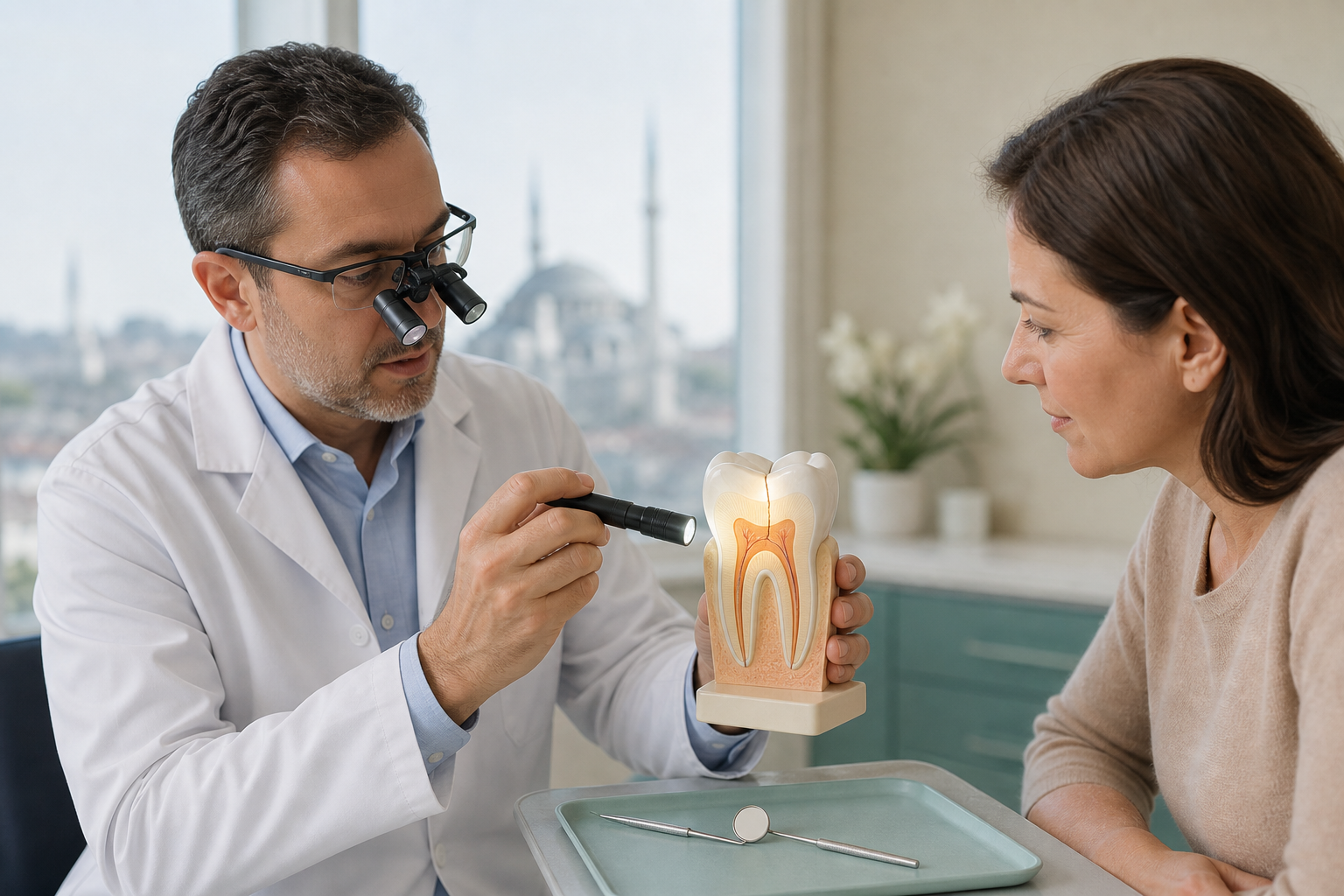
Clinical review required: Cracks are three-dimensional and may be difficult to detect. Treatment depends on crack location and depth, pulp and periodontal findings, remaining structure and whether the segments are complete or separable.
What is a cracked tooth?
A cracked tooth contains an incomplete fracture line in enamel and dentine that may extend toward the pulp or root. Unlike a fully split tooth, the segments have not completely separated. Cracks vary from harmless superficial craze lines to deep structural fractures. The term “cracked tooth syndrome” describes a pattern of symptoms, not a single uniform disease.
Craze line, crack or split?
Craze lines are shallow enamel lines commonly seen with age and usually need no treatment. A fractured cusp separates part of a chewing surface, often around a filling. A cracked tooth has an incomplete line, while a split tooth has separable segments and is often not maintainable as a whole. A vertical root fracture begins or extends within the root and carries a different prognosis.
Typical symptoms
Classic symptoms include sharp pain on biting or as pressure is released, intermittent cold sensitivity and difficulty identifying the exact tooth. Symptoms may come and go because the crack flexes under particular loads. Lingering temperature pain or spontaneous pain can indicate pulpal inflammation. Some cracks are painless and discovered during restoration replacement.
Why cracks are hard to diagnose
Crack lines are often too fine or poorly oriented to appear on routine radiographs. Symptoms can resemble decay, a high filling, sinus pain or another tooth. The dentist combines history, magnification, transillumination, staining when appropriate, selective bite tests, periodontal probing, pulp tests and removal of restorations where justified.
What a deep isolated gum pocket means
A narrow deep probing defect aligned with a crack can suggest extension beneath the gum or into the root and is associated with a less favourable prognosis. It is not diagnostic by itself; local calculus, anatomy or a periodontal lesion can also produce depth. Findings should be mapped and interpreted with the full examination.
Can CBCT show a crack?
CBCT can reveal indirect signs such as local bone loss and may identify some root fractures, but tiny cracks can remain below resolution or be obscured by restorations. Metal artefact can reduce clarity. A normal scan does not rule out a crack, and the radiation exposure must be justified by a specific diagnostic question.
Why teeth crack
Risk factors include large restorations, unsupported cusps, repeated heavy loading, biting hard objects, thermal cycling, tooth anatomy and loss of internal structure. Root-canal-treated teeth may be structurally compromised by previous disease and restorations, although treatment itself is not the only cause. A single bite event can reveal a crack that developed over time.
Immediate self-care
Avoid chewing hard food on the suspected tooth and arrange assessment. Do not repeatedly bite objects to reproduce pain. Keep the area clean and use pain medicine only within personal safety limits. Swelling, fever, severe spontaneous pain or facial spread needs urgent care.
Monitoring
Selected shallow, asymptomatic cracks with stable structure may be documented and monitored. Records can include photographs, probing, pulp tests and symptoms. Monitoring does not mean ignoring a high-risk tooth; it is a defined plan with review triggers. New biting pain, lingering cold pain or an isolated pocket changes the risk assessment.
Direct bonded restoration
Composite can stabilise selected cracks and replace defective fillings while conserving tissue. The dentist removes decay and unsupported material, evaluates the crack and controls bite contacts. Direct restoration may be definitive or provisional. It cannot guarantee that a crack has stopped at the visible boundary.
Onlay or crown
Cuspal-coverage restorations bind vulnerable cusps and redistribute load. An onlay can preserve more tooth structure, while a crown may be selected for extensive damage. Early coverage is sometimes recommended for symptomatic structural cracks, but preparation also has biological cost. The restoration protects; it does not erase the fracture line.
Does a cracked tooth need root canal treatment?
Not automatically. If the pulp remains healthy or reversibly inflamed, structural protection may preserve vitality. Root-canal treatment is considered for irreversible pulpitis, necrosis or apical disease. The decision should be based on pulp diagnosis, not the mere presence of a visible line.
Root canal plus cuspal protection
When endodontic treatment is necessary and the tooth is restorable, a bonded core and suitable cuspal coverage commonly follow. Systematic reviews show many treated cracked posterior teeth survive, but prognosis is poorer with deep periodontal involvement or extension into the root. Review remains necessary after symptoms settle.
When extraction is considered
A split tooth, vertical root fracture, crack extending deeply with an untreatable periodontal defect or insufficient sound structure may require extraction. In some multirooted teeth, removal of a fractured root and restoration of the remainder is occasionally possible. The replacement plan should be discussed before irreversible treatment.
Can a crack be sealed or healed?
Dental tissues do not fuse a structural crack in the way bone heals. Bonding and coverage can limit flexure and seal accessible areas. The pulp and periodontal tissues may recover if inflammation is controlled. No clinician can prove that every microscopic extension has been eliminated.
Bite adjustment and night guards
Selective adjustment may be considered when a specific interference overloads a vulnerable cusp, but indiscriminate grinding is irreversible and cannot treat a deep crack. A night guard can reduce some restoration loading in a bruxism patient. It does not repair the crack or guarantee prevention of progression.
Cracks beneath existing crowns
A crowned tooth can still crack, especially if the original fracture progressed or the root is involved. Diagnosis may require crown removal, periodontal mapping and endodontic assessment. Recementing a loose crown without investigating repeated pain or local bone loss can delay definitive diagnosis.
Cracked front teeth
Anterior cracks may follow trauma and require assessment for displacement, root fracture and pulp injury. Transillumination and photographs help define the line. Treatment may range from observation and bonding to pulp therapy or restoration. Aesthetic repair must not obscure necessary trauma follow-up.
Prognostic factors
Important factors include crack depth and direction, whether it crosses the pulpal floor, isolated probing, pulp status, remaining tooth structure, restorability, bite load and maintenance. Prognosis is probabilistic. A tooth labelled “cracked” can range from highly maintainable to hopeless, so one survival percentage cannot represent all cases.
Follow-up
Reviews assess symptoms, bite, restoration integrity, probing, pulp vitality where relevant and radiographic tissues. Report swelling, a gum pimple, new mobility or recurrent biting pain. Long-term maintenance includes controlling decay, plaque, grinding consequences and failing restoration margins.
Treatment abroad
Request diagnostic images, probing chart, pulp diagnosis, photographs and the clinician's description of crack extent. Clarify whether a proposed crown is provisional protection or definitive care and who will manage later endodontic symptoms. A guarantee cannot override biological uncertainty.
Questions to ask
- Is this a craze line, fractured cusp, incomplete crack or split tooth?
- What evidence shows the crack depth?
- Is the pulp healthy?
- Would direct restoration or cuspal coverage preserve more tissue?
- Which finding would change the prognosis?
- What follow-up is required?
Frequently asked questions
Will an X-ray always show a crack?
No. Fine cracks are often invisible; radiographs mainly show other disease or indirect changes.
Can a cracked tooth be saved?
Many can, especially when the crack is contained and periodontal support is favourable. Split or vertically fractured roots have a poorer outlook.
Will a crown stop the crack?
Cuspal coverage reduces flexure but cannot guarantee that a deep fracture will never progress.
Why does it hurt when I release my bite?
Movement of cracked segments can stimulate the pulp during loading or release, but this symptom is not exclusive to cracks.
Sources and clinical review references
- Treatment outcomes of cracked teeth.
- Survivability of endodontically treated cracked teeth.
- Outcomes and survival of endodontically treated cracked posterior teeth.
- Outcomes and prognostic factors for endodontically treated cracked teeth.
Editorial review note: Evidence reviewed 22 July 2026. Named clinician review is required before indexation.